

About Robynn AI
Reviews 15
-
Hobart Glover 3 months ago
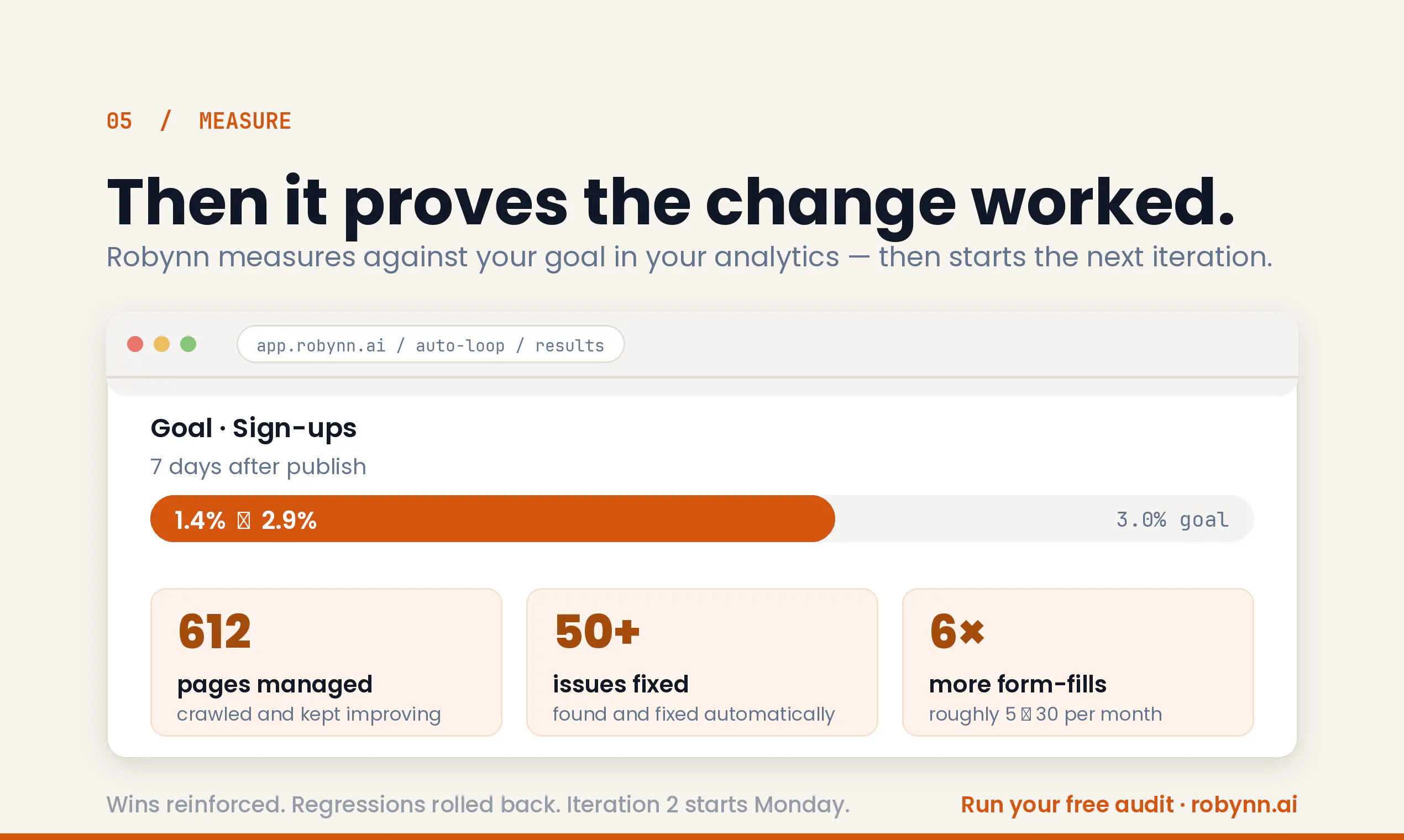
Congrats on the launch! The approve-before-publish workflow and automatic rollback are especially compelling. How does Robynn isolate the impact of a specific change in GA when several factors may be affecting traffic at the same time?
-
Korbin Effertz 3 months ago
This is intuitive. Does it audit automatically or on schedule...what triggers it ?
-
Sedrick Hirthe 3 months ago
"Wins get reinforced. Regressions roll back." is the sentence I'd stress-test, from someone who ships an AI that takes real-world actions and has been burned by exactly this loop. Two failure modes it doesn't cover, and neither shows up as a regression: The first is that rollback assumes the damage is visible in the metric you're watching. The changes that actually hurt are the ones GA scores as neutral or positive. A page that converts better because it overpromises is a win in the data and a support problem six weeks later. We shipped an AI summary that told a user their call had gone well when nobody had picked up — every downstream metric looked fine, because the failure lands on someone who isn't in your funnel. If reinforcement runs on the metric alone, the loop will happily climb toward things you'd reject on sight. The second is approval decay. "You approve" holds beautifully for the first twenty changes. Then it becomes a reflex — people approve to clear the queue, not because they read it. Now you have a human-in-the-loop on paper and an unsupervised agent in practice, and the audit trail says a human signed off, which is worse than no record at all because it looks like oversight. Nobody decides to lower the bar; it just drifts. What worked for us was gating on reach rather than on reversibility. Irreversibility is a bad axis because it over-fires on things nobody cares about and under-fires on things that are technically undoable and genuinely ruinous. Mapping to yours: a copy tweak on a low-traffic page and a change to your pricing page are both "reversible," and they should absolutely not sit in the same approval queue. Volume of low-stakes changes is what erodes attention for the high-stakes one. Concrete version, if useful: let auto-publish run unattended where reach is small, and reserve the human for a small number of high-reach changes — so approval stays expensive enough that people actually read it. Curious where you've landed on this: is the approval per-change, or can users set a reach threshold above which it always stops and asks?
-
Rocio Cormier 3 months ago
How do you decide when there's enough data to confidently label a change as a success or a regression, especially for lower-traffic websites?
-
Joany Hansen 3 months ago
the wins-get-reinforced, regressions-roll-back loop is the interesting part to me. GA signal is noisy and slow, especially for a lower-traffic site where a real ranking or conversion shift can take weeks to separate from normal variance. how long does Robynn wait before it calls a change a win or a regression, and does that window scale with the site's traffic volume so a small site doesn't get a false rollback from noise alone
-
Jackson Fisher 3 months ago
the email digest with a default-publish timeout is a fair middle ground honestly, at least it forces someone to actively ignore it rather than never seeing it at all. curious if the digest highlights which changes are lower-risk copy tweaks vs actual layout/pricing changes, since I'd guess most of the rubber-stamping risk comes from lumping trivial and consequential changes into one daily email
-
Charley Swift 3 months ago
Really interesting vision, @madhukar_kumar1 Website truly need continuous improvement, not just a one-time launch. Love the idea of AI handling the repetitive work while teams keep control over the final decision.
-
Michel Heathcote 3 months ago
Staging changes for approval before anything publishes is the detail that makes this usable on a real site, auto publishing would have been a hard no for me. Closing the loop through Google Analytics and rolling back regressions on its own is a nice touch. What actually triggers a rollback, is there a minimum traffic threshold before it decides a change hurt performance?
-
Quincy Medhurst 3 months ago
As someone who is not a marketer but loves to blog and has a personal website, I would like to try Robynn to increase traffic to my blog, I am tired of Linkedin as a way to share my writings, I would like something that persists. I would like people to read my blog six months after I have posted it, and hopefully Robynn can help me with better SEO and GEO rankings, does it do that?
-
Halle Wilkinson 3 months ago
The rollback is the part that got me. Most of these stop at telling you what's wrong, which just hands you another backlog. Closing the loop is the hard half - and once reverting is automatic you don't have to be right about any single change, just reversible. That's the whole trick. One thing I'd want: a holdout. I run a metrics dashboard for my own stuff and got burned by this recently - download numbers are weekday-driven, weekends run 40-60% below midweek, so every Monday looks like a win and every Saturday looks like a regression. Nothing to do with anything I shipped. Without a control slice you end up reinforcing the calendar. Congrats on the launch.
-
Quincy Medhurst 3 months ago
Nice launch. We have no web engineer and our site slowly rots, broken links and pages nobody has touched in a year, so a free audit that runs in minutes is tempting. Pointing at an element and describing the change in plain English sounds much better than filing a ticket and waiting. Does it work on a site built in a visual builder like Webflow, or does it need direct access to the code?
-
Garland Grady 3 months ago
the approve-before-publish step is the part I'm skeptical of, not the audits themselves. for a small team that's already stretched thin, isn't that approval queue going to turn into a rubber stamp after the first few weeks, the same way cookie banners and permission prompts do once people get used to clicking through them. if that happens the whole you keep the judgment pitch quietly stops being true even though the UI still shows an approve button.
-
Garnet Stokes 3 months ago
The rollback feature immediately builds confidence. Nobody wants AI publishing changes without a safety net. :D
-
Johnpaul Crona 3 months ago
It's refreshing to see AI focused on maintaining websites instead of just helping people build them. Too many websites become outdated as soon as they go live.
-
Enrico Wiza 3 months ago
How does Robynn distinguish between temporary ranking fluctuations and changes that actually need intervention?