

Second Brain for AI
Persistent memory for Claude, ChatGPT & Cursor. Free.
About Second Brain for AI
Reviews 15
-
Esteban Hilpert 5 months ago
This is a very helpful product.
-
Esteban Kilback 5 months ago
Semantic search over a personal memory layer is the right primitive here. Building on Cloudflare Workers keeps data distributed with low latency globally. With the self-hosted model and MIT license, is the vectorization step handled via Cloudflare AI bindings, or does it call out to an external embedding API?
-
Buck Yundt 5 months ago
Is this a shared memory for absolutely everything? In most AI systems there is chat memory and overall account memory. It seems to me that in such a service it should decide itself what to pass from memory and what not to, otherwise it will consume a lot of tokens.
-
Rylan Cremin 5 months ago
Honestly didn’t expect this. Product of the Day with 253 upvotes and 46 comments…. that’s more than I could have hoped for. Thank you to everyone who tried it, upvoted, and left thoughtful comments. Special shoutout to @anand_thakkar1 and @jim_jeffers … your feedback is already on the roadmap. That’s exactly why I build in public. And a huge thanks to @fmerian for hunting this. His advice shaped the launch more than anything else I did.
-
Roy Kris 5 months ago
The maker already shipped a CLI since launch — that’s useful signal. What’s the upgrade path for that CLI in terms of keeping it in sync with the web UI? Does it write to the same memory store, or does it maintain a separate local cache that could drift?
-
Garnet Stokes 5 months ago
Second question! ( I separate it so you get more engagement! haha) Could I connect this to a Raspberry Pi voice "flat mate" and use it as a shared memory layer? So I can access to all my ChatGPT memory with that home device too?
-
Dejon Bergstrom 5 months ago
Does this add continuity? Like timelime for the machine to understand that Its been 2 months I dont talk in that chat and It did not happen yesterday. I don't understand why is so difficult for ChatGPT to do this. I separate context in different chats... I've been using persistent memory and cross memory between chats in chatGPT since last summer ( apparently I was an advance user or whatever, and It got activated before). What I need is a TIME layer on it. Like timestamps / timeline awareness Memory without time is incomplete. Does this second brain fix this problem?
-
Jaylon Deckow 5 months ago
@rahilpirani Persistent memory across tools is something I keep running into as a builder. Does it work across different Claude/ChatGPT accounts or is it tied to the browser?
-
Kay Balistreri 5 months ago
The 'every conversation starts from zero' problem is real — I waste so much time re-explaining project context to Claude Code every new session. Self-hosted is a big plus for me. Curious about the MCP integration — does it expose memory as a tool that the LLM can call dynamically, or is it more of a pre-prompt injection layer?
-
Lance Morar 5 months ago
The forgetting problem is the actual bottleneck — not the quality of the model's reasoning. We've been building AI agents at Tuple for 18 months and the single biggest drop in usefulness happens at session boundary. A tool that routes around that without requiring the user to manage a "context file" is directionally correct. The self-hosted angle matters more than it might seem for B2B adoption — our clients will not put proprietary deal flow or client strategy into a vendor's cloud memory layer, full stop. Local or self-hosted is the only viable path there.
-
Dejon Bergstrom 5 months ago
Memory as a separate product (rather than a feature of one chat client) is the right bet. The interesting bit is conflict resolution: when Claude and Cursor have both updated the same project entry over the last day with different framings, what wins? Last-write, semantic merge, or surfaced to the user? That choice usually decides whether the layer feels like trust or like noise after a few weeks of use.
-
Kay Balistreri 5 months ago
the memory problem is so underrated in AI tooling right now. you spend 20 minutes setting up context in a conversation and then it just... vanishes. self-hosted is the right call too, especially for teams dealing with proprietary code. how does it handle conflicting memories across different tools?
-
Monserrate VonRueden 5 months ago
The between-session memory problem is real and this solves it well. The harder problem - at least for how I use AI - is within-session overflow. My conversations regularly hit 100K+ words before they die/lag to unusble. The context window can't hold it all anyway, so even within a single session I'm losing early context. What I actually want is a rolling summarizer that compresses as the thread grows - keeping the essential through-line while shedding weight. That plus persistent cross-session memory would be the full solution. This a great idea tho, one I really like!
-
Derick Koelpin 5 months ago
How does duplicate detection handle near-duplicates or nuanced variations in context? I've found that tricky in my own memory tools.
-
Neal Jacobson 5 months ago
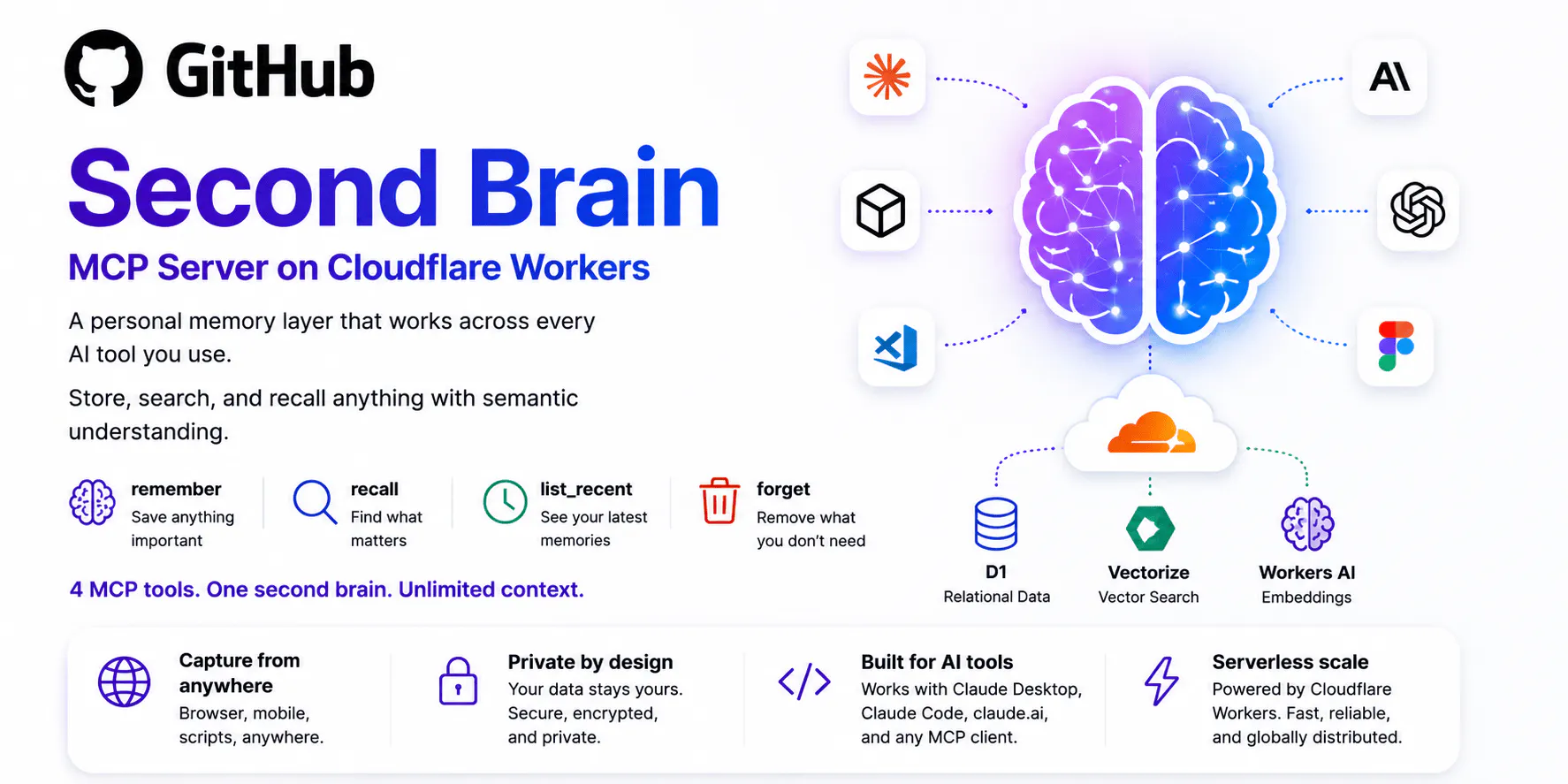
Quick update since launch. Here are a few things worth noting: We shipped the Second Brain CLI today. If you use the terminal, you can now capture and recall memories without leaving it. npm install -g second-brain-cf-cli For those asking about integrations, Second Brain works with Claude, ChatGPT, Cursor, Windsurf, and any MCP-compatible client. There’s also an Obsidian plugin in the community directory, a Chrome extension, iOS Shortcuts in the repo, and a web UI if you prefer managing everything visually. CLI, Obsidian, Chrome extension, iOS Shortcuts, MCP… same memory, every interface.