

Second Brain for AI v2
AI memory that connects the dots across every tool
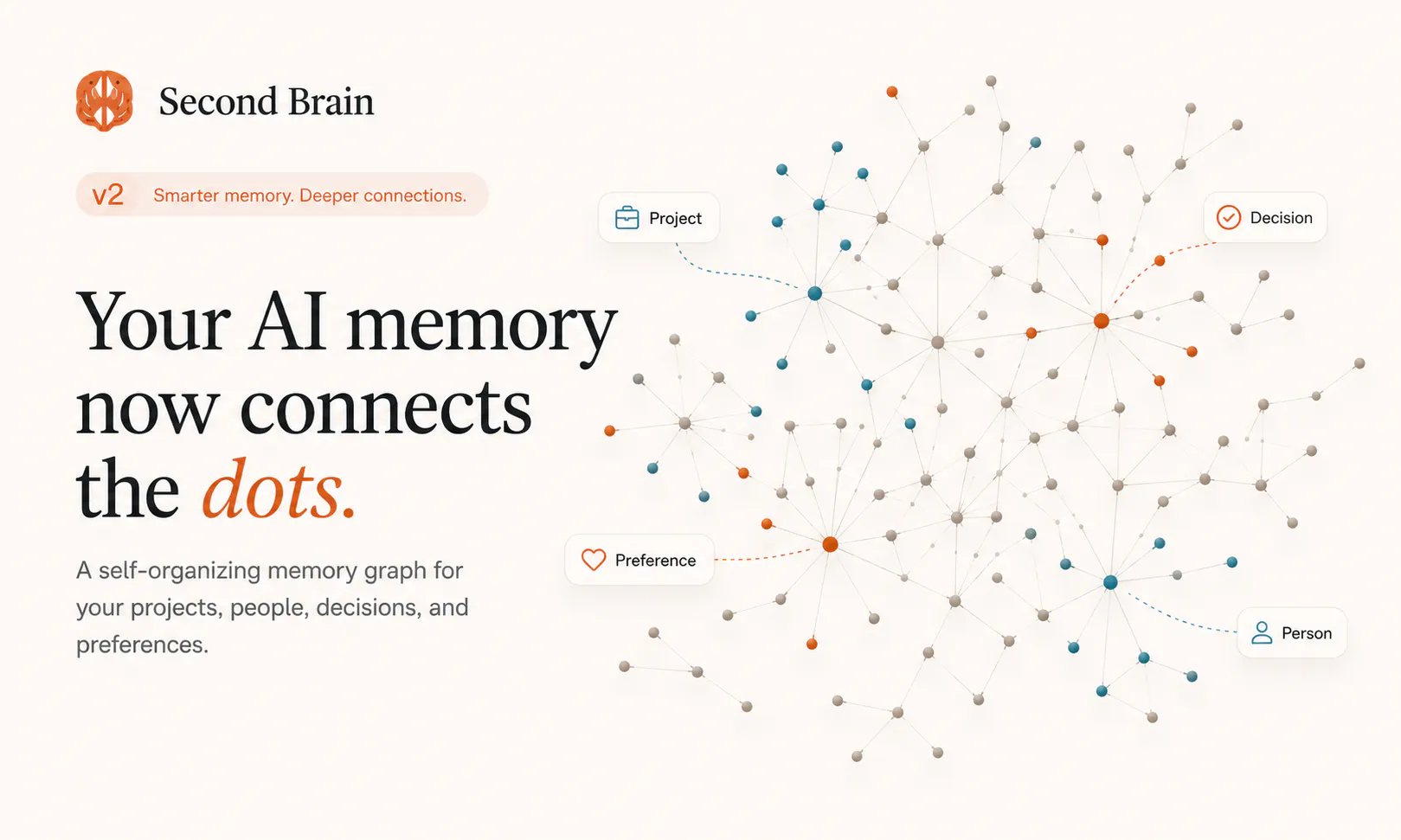
About Second Brain for AI v2
Reviews 15
-
Carter Volkman 4 months ago
Had to come back and leave one more update here. The comments on this launch did something I didn't expect. People flagged the terminal as a barrier. Others said git was intimidating. That feedback became the next thing we built. The Second Brain desktop app launches this Saturday on Product Hunt. Download, set a password, sign into Cloudflare. Five minutes. No terminal. No git. This launch shaped that one. Thank you for that.
-
Merl Orn 4 months ago
Multi-hop recall is where this becomes more interesting than semantic search. How do you evaluate whether a surfaced connection is genuinely useful rather than merely related—and can users understand why the system followed that particular path?
-
Elmer Schoen 4 months ago
I don't just build Second Brain. I use it every day. Today I stored every comment, every piece of feedback you all left on the launch. Then asked it to tell me what v3 should focus on. That screenshot is the answer. Top 5 on Product Hunt. Honestly didn't see that coming. Thank you. Every comment, every upvote, every share, it's what makes building this worth it. You're not just users, you're shaping what this becomes. v3 is already taking shape because of you.
-
Malachi Armstrong 4 months ago
@rahilpirani that "own the data, own the overwrite decision" framing makes sense. flip side of it being my Cloudflare account - if a bug on your end (not user error) corrupts the graph, is recovery also on me to have set up my own D1 backups/point-in-time recovery, or does Second Brain ship some backup mechanism by default so self-hosting doesn't quietly mean "you're also now responsible for your own disaster recovery"
-
Karley Frami 4 months ago
I often work across multiple agents, but messages and memory are not shared between them, which means I need to frequently copy context back and forth. The appearance of Second Brain is truly a lifesaver!
-
Rylan Hyatt 4 months ago
Nice upgrade for the second shot bro. How does it resolve the conflict? Does it deterministic? What happen if (Could I) revert to history question because of decision changes or bad responses?
-
Michel Heathcote 4 months ago
That's a clean model — surfacing draft-vs-canonical at write time with source + timestamp is the right primitive. The case I keep hitting in my own domain (character memory for fiction) is a third one: not a hard conflict, but soft drift. "She's cautious" → "she took a risk once" → "she's a risk-taker." No single write trips a conflict detector, yet the canonical quietly erodes. Have you thought about drift as a separate problem from hard conflict, or is that out of scope for the tool-sync case?
-
Santa Cassin 4 months ago
That's a clean model — surfacing draft-vs-canonical at write time with source + timestamp is exactly the right primitive. The hard part I keep hitting in my own domain (character memory for fiction) is the *third* case: not a clean conflict, but a soft drift where the new statement doesn't contradict the canonical, it just slowly erodes it. "She's cautious" → "she took a risk once" → "she's a risk-taker." No single write trips the detector, but the canonical is gone. Curious whether you've thought about drift vs. hard conflict as separate problems, or if that's out of scope for the tool-sync use case.
-
Rylan Hyatt 4 months ago
Is this open sourced?
-
Michel Heathcote 4 months ago
The "connects dots across tools" framing resonates — I've been working on cross-session memory for fictional characters and hit the same wall: memory needs to know what contradicts what, not just accumulate. Does Second Brain handle conflict detection when the same topic appears differently across tools, or is resolution left to the user?
-
Jedidiah Farrell 4 months ago
Your contradiction handling all keys off a competing signal — a second write disagrees, so it comes in as a draft. The case that bites me running a hand-curated file memory for my own agent has no such signal: a memory that was true when I wrote it, now false because the code moved underneath it, and nothing ever contradicted it. No competing write to open a draft, no reason to deprecate — it stays canonical and reads as trustworthy. You told Gal wrong-from-the-start is hard because there's no recency signal. This is its sibling: right when written, wrong now, still no signal. My only patch: stop treating recall as ground truth. Every entry reaches the model stamped with its age and a "verify before trusting" note, so even settled memory lands as a point-in-time claim. So does v2 pass age through to the model at recall, or does "canonical" itself read to the model as "trust this"?
-
Paul Kshlerin 4 months ago
As a solo dev I burn the first ten minutes of every Claude and Cursor session re-explaining decisions I already made, so a self-hosted memory layer is something I'd actually run. The canonical-vs-draft split, so a newer write doesn't silently overwrite a settled decision, is the sharp part here — treating recency as truth is exactly how these memory piles rot. Running it on my own Cloudflare free tier basically seals it.
-
Karley Frami 4 months ago
self-hosted and MIT licensed is the right call for something that's basically your whole context history - I'd never trust a memory layer like this if I couldn't see exactly where the data lives. the "canonical vs draft" distinction for handling contradictions is smart, most memory tools just let the newest write win and call it a feature
-
Paul Kshlerin 4 months ago
Cross-tool memory is the piece I keep wanting and keep not trusting, mostly because I can never see what it decided to remember. Does Second Brain let me look at and edit the actual memory it's built, or is it a black box I have to take on faith? The moment one of these quietly remembers something wrong I lose the whole thread, so the inspect-and-correct part matters more to me than the recall.
-
Charley Swift 4 months ago
Self-hosting the memory layer in my own Cloudflare account is what makes me willing to put real project context in it — the data staying mine is the whole ballgame. The V2 "distinguishes settled decisions from drafts and stale context" line is the part I'd stress-test: when Claude and Cursor write conflicting versions of the same decision, does it auto-pick the newer one, or is there a confirm step so I decide what's canonical? And is recall scoped per-project, or does every connected MCP client pull from one global pool?