

Second Brain for Mac and Windows
Your AI memory, everywhere you work
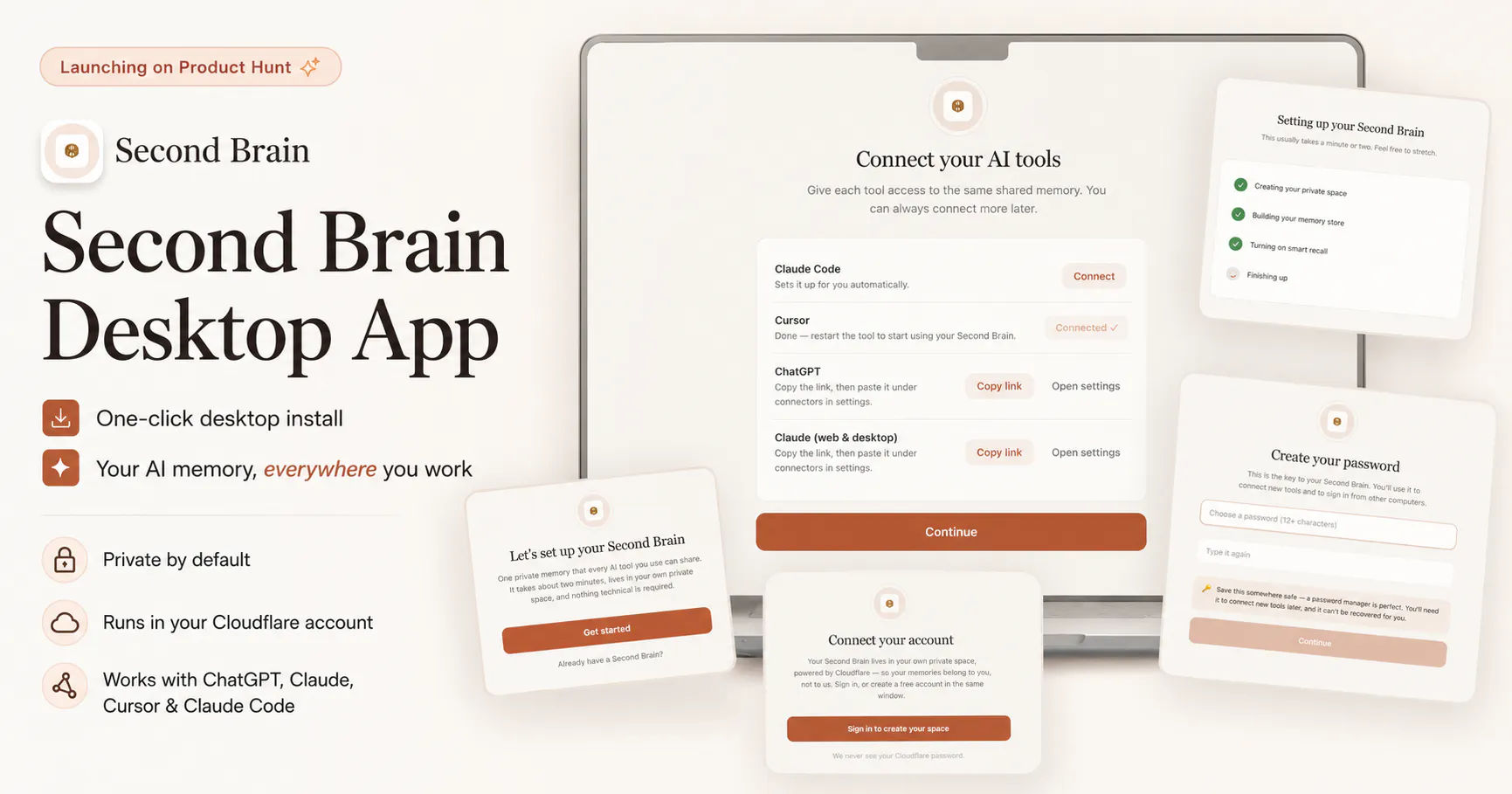
About Second Brain for Mac and Windows
Reviews 15
Thanks! Your review is posted.
Sign in to rate and review Second Brain for Mac and Windows.
-
just now
-
Ulises Ankunding 3 months ago
@rahilpirani congrats on the launch - very impressive and the "starting over" is a real issue. Why do you think the LLMs force a start over - does it have to do with token usage?
-
Karley Frami 3 months ago
How does it handle large conversation context? Will it clear the older conversation context or it preserves it forever?
-
Hugh Borer 3 months ago
Does it go with claude code or codex, I mean in terminal, I work on multiple side projects over claude code terminal, with this brain can I simply talk about my expectations, it will pick automatically?
-
Makenna Eichmann 3 months ago
The override versus accumulate question above is the real one. Semantic search alone can't answer it either. An old architecture decision and its replacement will usually score just as similar to each other as either does to the query looking for it. That has to get resolved somewhere: at write time, checking new entries against existing ones and versioning what's superseded, or at read time, dumping both into context and trusting the model to notice the contradiction. Which is it here?
-
Constantin Leuschke 3 months ago
Congrats on the launch. How portable is the memory layer if someone later wants to move off Cloudflare? Can they export the raw memories, graph edges, canonical status, and provenance in a format another system can rebuild without losing the relationships?
-
Demetrius Gulgowski 3 months ago
The line about surfacing the right memory, not just the newest one, is the hard part, and it is good to see it treated as its own feature instead of folded into search. The thing that usually breaks recall in practice is contradiction over time. March says Postgres, July says SQLite, and pure similarity happily hands back both. Curious whether the knowledge graph does any supersede or invalidate work there, or whether ranking is still semantic distance plus recency. Keeping the data in the user's own Cloudflare account is the right default too. Congrats on the desktop launch.
-
Curt Nienow 3 months ago
I've been hand-maintaining something like this for months — a memory index plus per-topic files I update after every session — and the hardest part isn't storing new context, it's knowing when something old stops being true. A canonical memory that was accurate for a year but describes a relationship or process that's since changed completely — does anything nudge you to review or archive it, or does it just sit as ground truth until a new note happens to contradict it? That's the part that quietly breaks trust in any memory system once it's been running long enough to accumulate stale "facts."
-
Duncan Effertz 3 months ago
The problem you are solving is so real, I keep re-explaining my whole project to every new chat like it is our first date. One click deploy to Cloudflare sounds lovely. If I use it with both Claude and Cursor, do they share the exact same memory pool or can I split things per tool?
-
Zachariah Hudson 3 months ago
Congrats on shipping this. Self hosted on my own Cloudflare account with MCP support is exactly the setup I want for memory, no third party holding my context. How does the duplicate detection work when two memories say roughly the same thing in different words, does it merge them or keep both?
-
Adam West 3 months ago
The trajectory of the usefulness of this tool will only continue to rise as time passes and we have too many tools to count— nice work on this— are you planning on going a similar direction as obsidian or a different one?
-
Neal Jacobson 4 months ago
that's really clever. how does it handle when two memories contradict each other?
-
Korbin Effertz 4 months ago
Shipping a desktop installer on top of self-hosted Cloudflare memory removes the git barrier without giving up the your-account data model. Semantic recall plus a graph you can inspect is more useful than dumping the newest note into every chat. How do you scope memories per project or client so Cursor does not pull unrelated brand voice into a new codebase?
-
Rahul Goyette 4 months ago
I think making the setup frictionless is just as important as improving the memory itself. A lot of developer tools lose people before they ever experience the core value because the first 15 minutes are too much work. Getting someone from download to actually using persistent memory in a few minutes is a bigger improvement than it might seem.
-
Santa Cassin 4 months ago
A lot of people have been asking how memories are stored and whether they sync across devices. This diagram explains it better than words can. The desktop app is how you install and access Second Brain. Your memories live in your own Cloudflare account, not the app and not our servers. Switch from Claude to ChatGPT to Cursor, your brain is already there. Uninstall the app, your memories are still there. The app is the door. Cloudflare is the house.
-
Sedrick Hirthe 4 months ago
@rahilpirani The no-terminal, pre-authenticated setup is a smart move for adoption. One question does the desktop app sync memories in real-time across multiple devices, or is it single-machine only for now?