

About Termi Protocol
Reviews 15
-
Jaiden Runolfsson 2 months ago
i wonder if the 3d layer eventually becomes less useful as people get better at supervising agents. have you thought about the opposite problem, what information can you progressively hide as trust in an agent grows?
-
Santa Cassin 4 months ago
the visualization solves the "is my agent working or hallucinating" problem instantly. i've been staring at scrolling logs for weeks and this is basically the diff. real q: when claude and codex share a repo, is there a way for the human (or a third agent) to sign off on which commits actually shipped good work vs which shipped garbage? that trust signal would compound over time and route future tasks to whichever agent is best at what.
-
Rocio Cormier 4 months ago
Congrats on the launch! Any plans to visualize non coding agents too? Such as research or marketing agents?
-
Johnathan Homenick 4 months ago
The state I can never eyeball fast in scrolling logs is idle-waiting-on-approval versus stuck-in-a-retry-loop. They throw off similar output volume but mean opposite things, and I usually notice the difference three minutes too late. If the room made those two visually distinct at a glance, an agent standing still at the desk versus pacing and redoing, that's the thing that would earn the screen space over an 8 hour session for me. Does the body reflect that an agent is actually blocked, or just that it's between commands?
-
Conner Jacobs 4 months ago
Everyone is asking how the room shows agent state - the state I care most about is mine. Running several agents, the biggest silent time sink is agents sitting blocked on my approval while I look somewhere else. The room shows their work; the killer view would be my inbox: one glance at everything currently waiting on me, oldest first. Is there anything like that today, or is approval surfaced per agent only? Congrats on the launch!
-
Malachi Armstrong 4 months ago
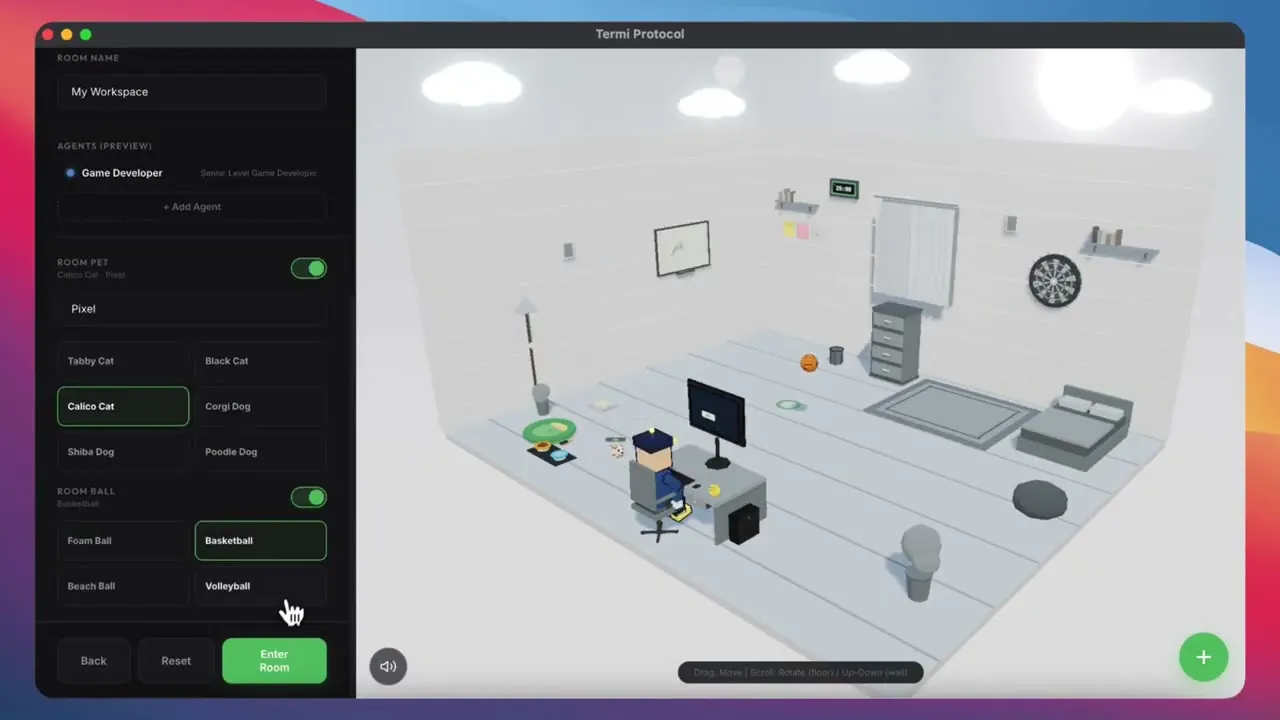
Love that you went with a 3D live view instead of just streaming logs or a diff feed. Watching an agent actually "build" in space is such a fun way to make something abstract feel tangible, way easier to stay engaged than staring at a terminal.
-
Floyd Botsford 4 months ago
the question that decides whether this is a toy or a tool: how tightly is the 3d scene wired to real telemetry? like the agent walks to the desk on a file write and stands at the whiteboard while planning? and can i act from inside the scene, click the agent that has been pacing in circles for ten minutes and see its last three tool calls? if watching becomes steering, this goes from cute to genuinely useful for multi agent runs.
-
Rupert Emmerich 4 months ago
The watch-it-work idea is strongest when the room has a hard mapping to operational state, not just animation. For coding agents I would want every visible action to answer one of four questions: what file/process is currently owned, what decision is waiting for approval, what checkpoint can I roll back to, and what changed since the last human review. A useful test case would be two agents touching adjacent files during a refactor. If the 3D room can show lock ownership, blocked/waiting state, command output risk, and the exact diff/checkpoint boundary without opening a terminal first, then it becomes a control surface. If I still need to read the raw logs to know whether to pause or approve, the room is mostly a pleasant monitor.
-
Jarrell Homenick 4 months ago
Eric, I'm the exact target here, a solo dev running Claude Code all day, so "logs never showed me what they were actually doing" hits home :) Honest question: does the 3D actually change how you steer the agents, or is it delight on top? For one agent, watching a robot walk to its desk risks becoming visual noise after 8 hours. Where it'd be indispensable is the multi-agent case, does the room really encode state (this one holds a lock, this one's blocked) so you see a collision before it lands? That's the line between the product and a beautiful skin. Congrats on the launch! ;)
-
Franz Bauch 4 months ago
The visualization angle is interesting if it helps debug handoffs, not just make agents look fun. I'd be curious whether command/log events can be replayed later, because that would make it much more useful for reviewing failed runs.
-
Garnet Stokes 4 months ago
Hello Eric. Congrats on the launch, very fun idea! How exactly can I control the agents if I just see them in 3D? These checkpoints are saved in local cache or inside the Termi server? Thanks let's connect :)!
-
Joany Hansen 4 months ago
Will watching them not burn more tokens? and be shit more expensive?
-
Daren Bruen 4 months ago
Exactly the answer I was hoping for — attaching to running sessions and keeping the render local is what makes it usable day to day. On the attach mechanism: does Termi tap the session by reading the PTY/terminal output, or hook into the agent process directly? And if I have two or three agents going at once (say Claude Code plus Codex), do they share one room or spawn separate ones?
-
Esteban Hilpert 4 months ago
Congrats on the launch. The local-first angle is the part I’d trust most here. For AI coding agents, visibility is useful only if it helps me make a decision: pause, approve, rewind, or compare what two agents changed. One small suggestion: make the “why this step happened” trail as important as the 3D view. Commands run, files touched, checkpoint reason, and approval history would turn this from a fun visualization into a review tool I could actually rely on.
-
Adam West 4 months ago
The idea is really fun! Now I wonder - how deep it is connected with real activity of agents. Will it help to get visual signal that something is going wrong and can user control agents through those 3D models, or they are working only one side, just visualising the process?