

About TestSprite 3.0
Reviews 15
-
Monserrate VonRueden 5 months ago
I genuinely did not expect to be this impressed. I've spent days manually testing projects and chasing bugs across components and the idea of a fleet of parallel agents covering everything simultaneously in minutes is just brilliant. As someone currently building multiple projects this would save me so much time and frustration. Does it work well with smaller solo projects or is it more suited for larger team codebases?
-
Joany Hansen 6 months ago
This sounds really cool! For a complete end toe end SaaS, will TestSprite be enough or do we have to complement it with other tools to have a full audit?
-
Fidel Davis 6 months ago
I am running tests for a generic company landing page — no backend, no database, and all assets were aggressively dragged into a GitHub repo and Cloudflare :) https://bgrglobal.co/ The features include: Photos and company introduction Multiple articles were written by the company Contact information TestSprite v3.0 brought many interesting improvements: It fully understands the visitor journey It creates meaningful test planning like a real visitor It executes simulated visits just by being given the URL Some features, like localization and email contact CTAs, were things I did not even care much about. But TestSprite carefully dug into the details and caught issues that were not okay. I believe this software should be introduced to more people who have already learned vibe coding, but have not yet learned vibe testing.
-
Derick Koelpin 6 months ago
Looks great. I’ll give it a shot. Qq: how do the credits work?
-
Murray Kuhlman 6 months ago
Most testing tools make you write the test cases first, which means you're already guessing what to test. Having agents explore the app like real users before generating any tests is a smarter order of operations. Wondering how it handles role-based access — if agents hit a login wall early, how much of the app actually gets covered?
-
Jaiden Runolfsson 6 months ago
@jiao_yunhao @shawnie_shan , One thing I’m curious about: have the exploration agents ever uncovered product problems rather than software bugs? In my experience, some of the most expensive failures aren’t broken feature, they’re perfectly working workflows that users misunderstand, abandon, or use in unexpected ways. Have you seen TestSprite surface those kinds of insights during exploration, or is it intentionally focused only on test generation?
-
Nikunj 6 months ago
It feels like AI coding tools are moving faster than testing infrastructure right now. Do you see TestSprite becoming part of the default AI development stack?
-
Enrico Wiza 6 months ago
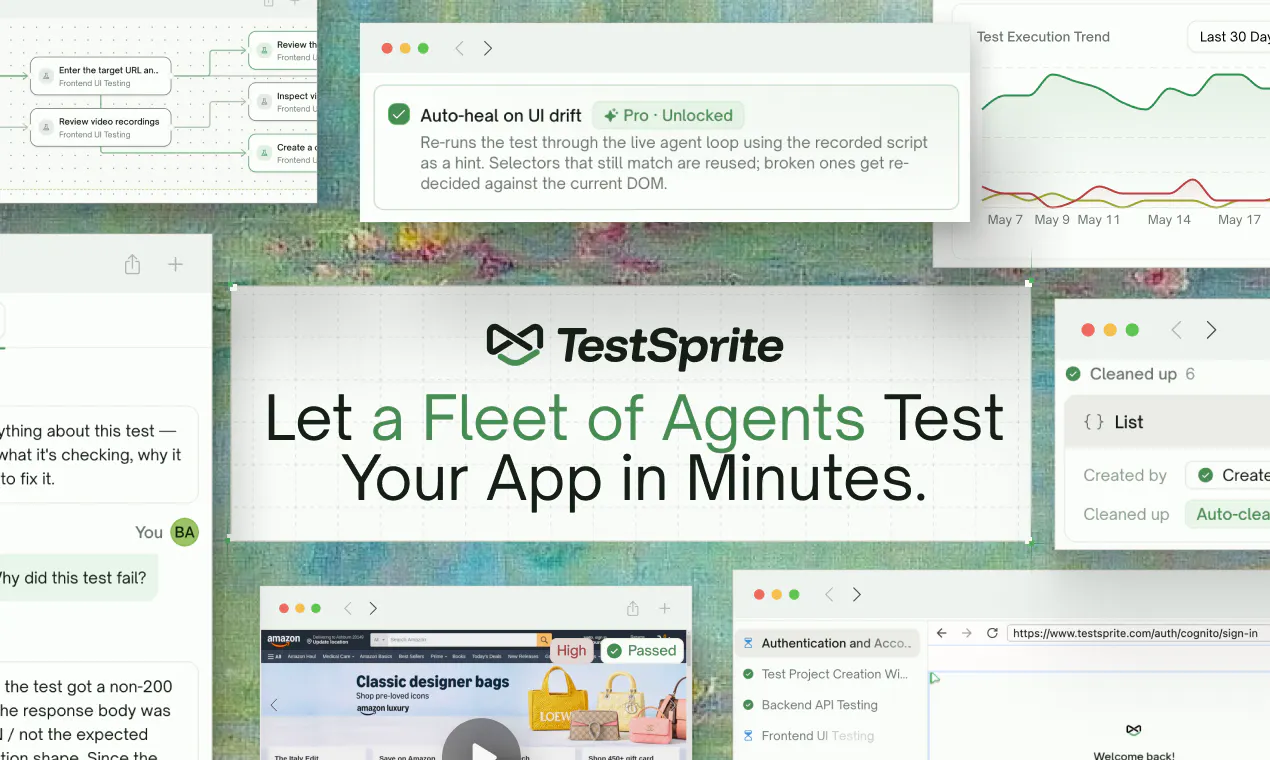
I’ve been with the @TestSprite team for a while, and 3.0 feels like the version where the product got much more practical. Now, instead of guessing at what your app does, TestSprite sends out a fleet of parallel AI agents to explore it first — almost like real users poking around — then generates tests from what they observed. This is a key differentiator from most “AI testing” products that feel like asking a coding agent to squint at your app and hope for the best. TestSprite is pushing toward something more concrete and ambitious: hundreds of parallel agents that explore, generate, and run tests at scale, and then Ralph Wiggum healing broken features. Also: the CLI story is spicy! 🌶️ The team described an internal “Gundam mode” where Cloud Code + TestSprite CLI + AWS CLI can keep coding, testing, checking logs, and iterating for days. That’s the bit I’m looking forward to trying!
-
Monserrate VonRueden 6 months ago
Congrats on the launch! 🎉 The exploratory-testing-by-parallel-agents framing is the interesting move — QA traditionally treats exploration as the part you can't automate, only deterministic scripted runs. One question: when auto-heal fixes UI drift, how do you prevent a 'false pass' where the heal silently masks a real regression? Curious where the line sits between adaptation and over-tolerance.
-
Marcelo Prohaska 6 months ago
As a solo dev building small SaaS tools, testing is always the first thing I skip when rushing to ship. The "90% cost reduction" claim is bold — curious how it handles edge cases in backend API testing specifically. Does it work well with lightweight stacks like Vercel + serverless functions?
-
Neal Jacobson 6 months ago
Curious how TestSprite handles visual regression for design tokens specifically — if a colour or spacing token changes upstream in a design system, does the agent catch that drift across every affected component automatically, or is visual diffing still a separate manual step on top of the functional tests?
-
Jaiden Runolfsson 6 months ago
Really curious — when the agents explore an app, do they sometimes discover workflows or edge cases that developers themselves overlooked?
-
Derick Koelpin 6 months ago
Parallel agents for testing is the right approach running tests sequentially is the bottleneck nobody talks about. Does it work for iOS/mobile apps or mostly web? That's where I'd love to use this.
-
Marcus Macejkovic 6 months ago
This sounds awesome, particularly PRD to test case development! I gotta connect the MCP to Brief.
-
Jake Blanda 6 months ago
Parallel testing agents sound useful. How do you handle flaky state like auth setup, seeded data, and third-party APIs so the agents report product bugs instead of environment noise?