

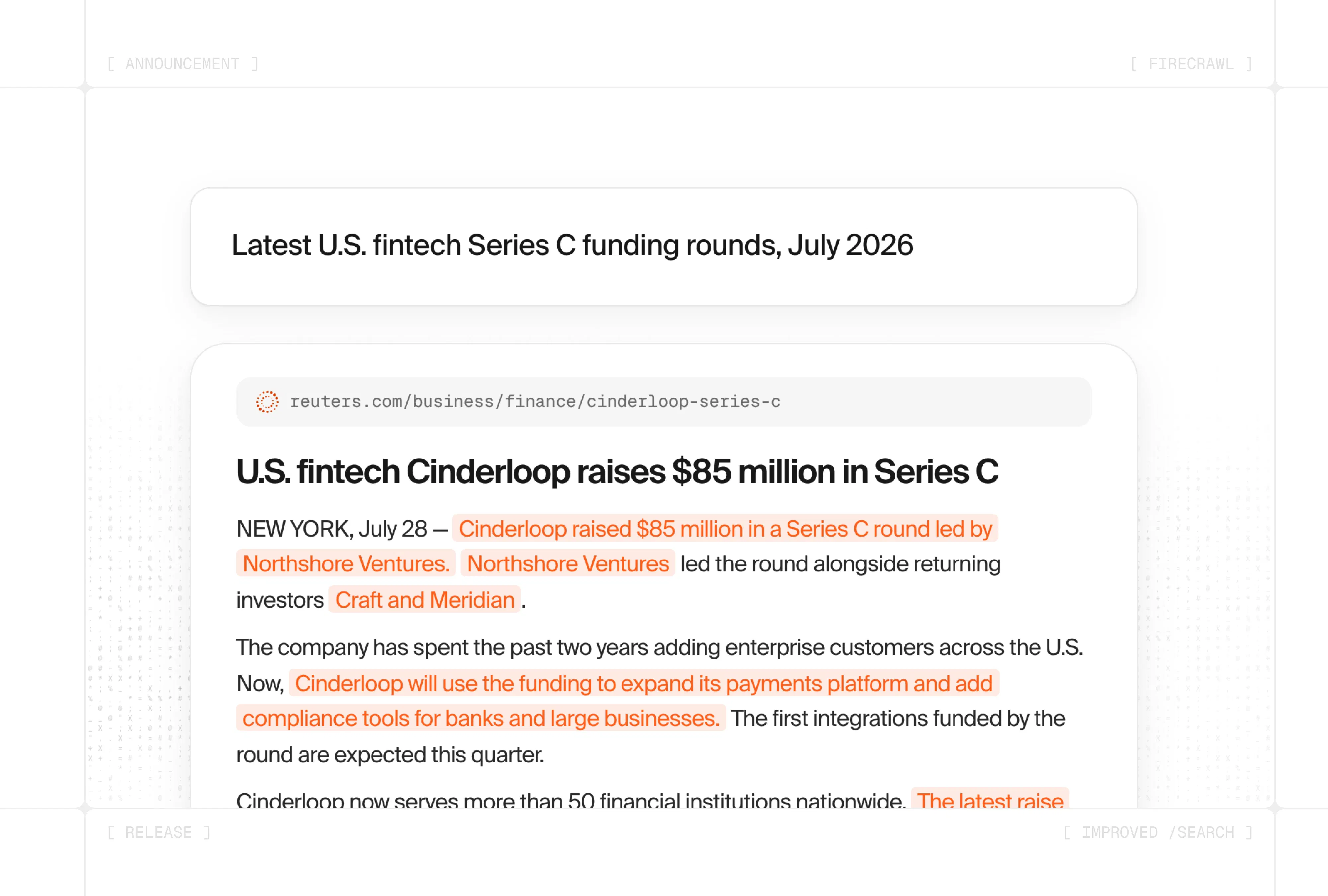
About The new Firecrawl /search
Reviews 15
-
Eino Klein 3 months ago
the 10x token reduction is the part that jumps out to me, not just the accuracy number. most search integrations I've tried just dump raw page text and let the model figure out what matters, which quietly burns budget on long research chains. curious how the relevance model handles queries where the "best" excerpt is actually split across two non-adjacent sections of a page - does it stitch those together or just pick the single strongest paragraph?
-
Blaze Koepp 4 months ago
if these numbers are true, holy moly lock your doors and hide. The giants might not like this. But I love that it uses as few tokens as possible. Right now token usage is HUGE. This helps the bubble not pop.
-
Wiley Lubowitz 4 months ago
a small eval set comparing search quality for agent tasks, not just human search. For example freshness, source diversity, deduping, and whether results are easy to turn into cited answers.
-
Michel Heathcote 4 months ago
the 10x fewer tokens number is what'll get this adopted fast. curious about the relevance model's language coverage though - was the 94.7% SimpleQA number an English-only benchmark, and does the excerpt scoring hold up the same way on non-English source pages, or is there a noticeable accuracy gap once the query and the page aren't in English?
-
Nils Auer 4 months ago
The /search endpoint is the piece I've been waiting for — structured web data straight into the pipeline instead of scraping + cleaning by hand. For SEO/content ops this cuts the "research" step from hours to minutes. What's the rate limit story like at scale?
-
Franz Bauch 4 months ago
does the response expose a per-excerpt relevance score, or just the model's own cutoff? asking because in an agent chain I'd rather set my own threshold than trust a black-box cutoff on which excerpts made it in.
-
Elmer Schoen 4 months ago
The excerpt approach is a clean tradeoff for factual lookups where the signal is usually in one paragraph. Curious how the model handles research queries where the evidence is spread across 3-4 short paragraphs on the same page, or where two sources directly contradict, does it surface multiple excerpts per result, or one best-match per page? That gap is where we've seen agents get confidently wrong answers from snippet-based search.
-
Blaze Koepp 4 months ago
Benchmark scrore is really good. What are the scenarios where it failed to answer correctly?
-
Franz Bauch 4 months ago
94.7% on SimpleQA is impressive. How does the relevance model handle ambiguous queries?
-
Rylan Cremin 4 months ago
The 10x fewer tokens claim is the part that caught my attention. In agent workflows, the expensive failure is often not retrieval itself, but letting the model chew through irrelevant page structure. I’d be curious to see where the relevance model struggles most: tables, long docs, or queries with several equally plausible answers?
-
Hillard Halvorson 4 months ago
Congrats on your launch! 🚀
-
Burley Collins 4 months ago
firecrawl has become the default answer every time someone in the agent space asks "how do i give my agent reliable web access." that kind of organic word of mouth in developer communities is hard to manufacture. the "interact with" part beyond just scraping is where it gets interesting for agentic use cases. filling forms, clicking through flows, handling dynamic content that only renders after javascript executes. curious how the rate limiting and retry logic works when a target site starts throttling requests mid-crawl.
-
Al Wolf 4 months ago
That's a solid benchmark score. Does the relevance model retrain continuously or is it a fixed release?
-
Jarrell Homenick 4 months ago
94.7% on SimpleQA is a strong number, but that benchmark is specifically short factual questions with a fairly clean right answer, which is close to the best case for a relevance model scoring paragraphs against a query. Curious how much that accuracy holds up on queries where the right answer isn't a single fact but requires synthesizing across multiple excerpts, since scoring individual paragraphs and lists against a query is a different task than judging whether the combination of several partial excerpts actually adds up to a complete answer. Also, returning excerpts instead of full pages means the model never sees the surrounding context that a paragraph originally sat in. If a relevant looking paragraph is actually a counterexample, an outdated caveat, or a quote the source page was explicitly refuting, does the excerpt carry any signal that it needs to be read skeptically, or does stripping the surrounding page context risk agents treating pulled quotes as more authoritative than the original author intended.
-
Jackson Fisher 4 months ago
The excerpt model is a smart place to spend the effort. One thing I'd poke: it works on pages you already retrieved. For grounding, the failure I hit most isn't a found page being too long, it's the one page that actually holds the answer never making it into the result set at all. SimpleQA rewards well-covered facts. The queries that hurt are the long-tail ones where the answer sits on a single thin, badly-linked page. Excerpt selection can't rescue a page that never surfaced. Two things I'd want to know: does the new model touch recall, or only what you do with what's already retrieved? And on those thin pages, does aggressive excerpting ever drop the one passage that mattered, to save tokens?