

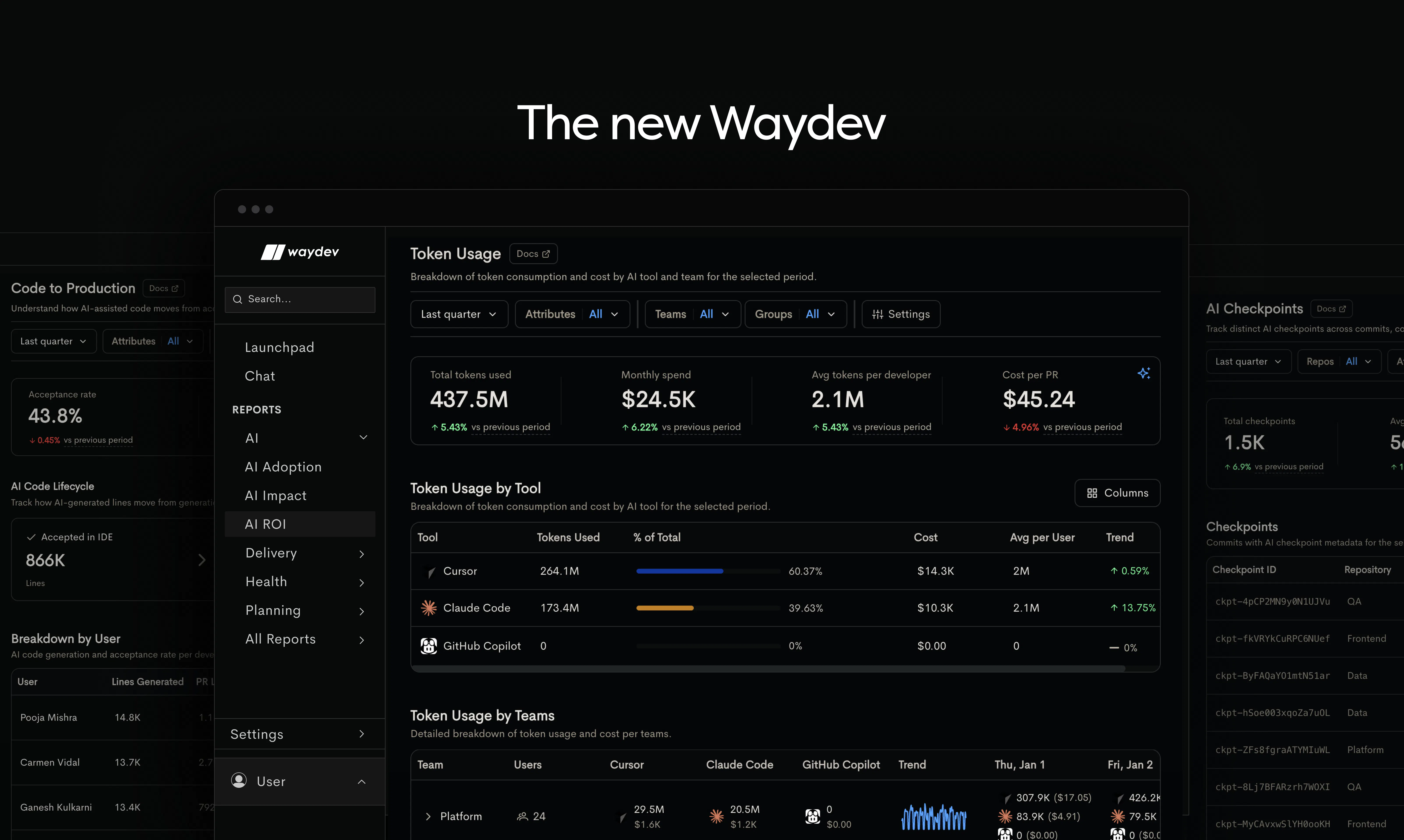
About The New Waydev
Reviews 15
-
Nils Auer 7 months ago
"4% of public GitHub commits authored by Claude Code" is a genuinely wild stat — AI spend is a growing line item with no outcome telemetry. Commit-level attribution + cost-per-shipped-PR is the observability layer nobody built yet. The "system optimization, not surveillance" framing is the hard social-contract part of this.
-
Adam Zemlak 7 months ago
Development will very soon move to AI-first programming. We have already started doing some projects where Claude Code writes all the code, while our seniors set the tasks and monitor the output quality. It would be useful to evaluate the efficiency and quality of the generated code. After all, while there isn't much of it, it's not a problem, but if you program like this for a year, it's not a given that the codebase will remain easily maintainable.
-
Adam West 7 months ago
This is solving a real problem I hit as CTO. When we scaled from 15 to 120 engineers, we tracked everything - velocity, cycle time, PR throughput - but none of it told us whether the work actually mattered. AI tools make this gap even wider because raw output volume goes through the roof while the signal-to-noise ratio drops. Measuring from token to production instead of just counting lines is the right frame. Curious how you handle the attribution problem when a single feature touches both human-written and AI-generated code across multiple PRs.
-
Carter Volkman 7 months ago
This is a question I've been trying to answer internally for months - what percentage of AI-generated code actually makes it to production, and is it saving us time or creating tech debt we'll pay for later. The "cost per shipped PR" metric is smart because it ties AI usage directly to business output instead of vanity metrics like "lines generated." Curious how it handles the gray area - like when a dev uses Copilot to scaffold something, then rewrites 60% of it. Does that count as AI-written or human-written? That attribution problem seems really hard to solve cleanly.
-
Mike VonRueden 7 months ago
This is honestly something I've been wanting for a while. Been tracking my AI-assisted coding output manually and it's a mess — no good way to tell if Copilot or Claude Code actually saved time vs just shifting where the bottleneck is. The "token to production" framing makes sense because that's the real question: does more AI usage actually correlate with shipping faster? Curious how you handle the attribution when a dev uses multiple AI tools in a single PR.
-
Lance Morar 7 months ago
measuring actual shipped % of agent code is such a missing metric — everyone's tracking tokens spent, not outcomes. how do you handle attribution when a PR goes through multiple agents + a human review before merging?
-
Nils Auer 7 months ago
Token consumption tracking is interesting — how does that work in practice with something like Claude Code, which runs autonomously and can spin up multiple sub-agents mid-session? Are you capturing tokens at the session level, per file touched, or per PR? The attribution question gets messy fast when one 'task' spawns 40 tool calls across 3 agents.
-
Sedrick Hirthe 7 months ago
love that you're tracking acceptance rates by vendor. we've been debating Copilot vs Cursor internally and it's all gut feeling right now. being able to see "Cursor had 73% acceptance but Copilot code shipped 2x faster" would end those arguments quickly. does it handle when devs modify AI suggestions before committing?
-
Garland Grady 7 months ago
this is exactly what we've been missing. we use Cursor and Claude Code daily but have zero visibility into which suggestions actually make it to prod. the cost per shipped PR metric is brilliant - finally a way to measure actual AI ROI instead of just "feels faster." curious how the agent tracking works across different IDEs?
-
Chelsey Gottlieb 7 months ago
Is this for big enterprise or even for small startups? Also I didnt find the pricing model. Not sure what I missed.
-
Mike VonRueden 7 months ago
Congratulations for this release, I know how much work you and the team put into it. Now, this version looks like a very robust solution, love it! Can't wait to plug the new Agents into our workflows and see what we actually ship 🫡
-
Johnathan Homenick 7 months ago
Finally something that looks at actually measuring productivity beyond just lines of code. With AI agents, generating code is becoming the easy part, but the more important question is what actually makes it through review, ships to production, and creates durable value. Otherwise we risk confusing velocity of spitting code with actual progress. This feels like the right lens for understanding AI’s real contribution to engineering teams. The one question I'm still trying to figure out and I'd love your perspective: how do you connect these engineering metrics (output) with the business KPIs (actual business outcome)?
-
Korbin Effertz 7 months ago
Looks really cool. How do you compare against https://macroscope.com/ ? I like 1) their github integration and the code suggestions, 2) the the sprint analysis.
-
Marcelo Prohaska 7 months ago
Feels like something team actually needs right now, curious to see how it evolves with realworld usage.
-
Jaylon Deckow 7 months ago
A lot of engineering analytics tools get dismissed as “commit/LoC dashboards.” What product decisions did you make to avoid Goodhart’s-law behavior (PR splitting, metric gaming), and how do you recommend companies operationalize Waydev without turning it into an individual performance scorecard?