

About Tokenwise
Reviews 11
-
Garnet Stokes 5 months ago
honestly never dealt with LLM billing chaos myself but i can see why this exists, the amount of devs who complain about surprise API bills is insane the fact that it tells you what to cut instead of just showing you a graph is the actual useful part. dashboards are useless if they don't tell you what to do next and checking quality before cutting costs is something no one else is doing most tools just say 'use gpt-3.5' and hope for the best.
-
Jarrell Homenick 5 months ago
The shift from dashboard to apply is the right call. Every observability tool I have run hits the same wall: you have the numbers but no path from chart to fix without writing a migration script yourself. The A/B split on the apply step is the part that actually earns trust. Twenty four hours of quality scores on real traffic before a ramp is the difference between this and a vendor that just suggests a cheaper model and walks away. Question on the semantic clustering of prompt templates: how do you handle the case where two templates look semantically identical but have different system prompts that meaningfully change output? Do you cluster on the user message only or the full request shape?
-
Elmer Schoen 5 months ago
Are you talking about query optimization/compression? Something like what Google recently did with an algorithm that compresses prompts by 7x without losing quality?
-
Elias Rowe 5 months ago
We've had seven AI agents running in production since last year, and token costs were a complete black box until the invoice arrived. We built a basic per-model logger ourselves -- took more engineering time than it should have. The edge case I'd push on: can you attribute spend to a specific workflow or user journey, not just a model? When you're debugging why a particular sequence of agent calls got expensive, model-level rollups aren't granular enough. That's where the real cost surprises live.
-
Esteban Kilback 5 months ago
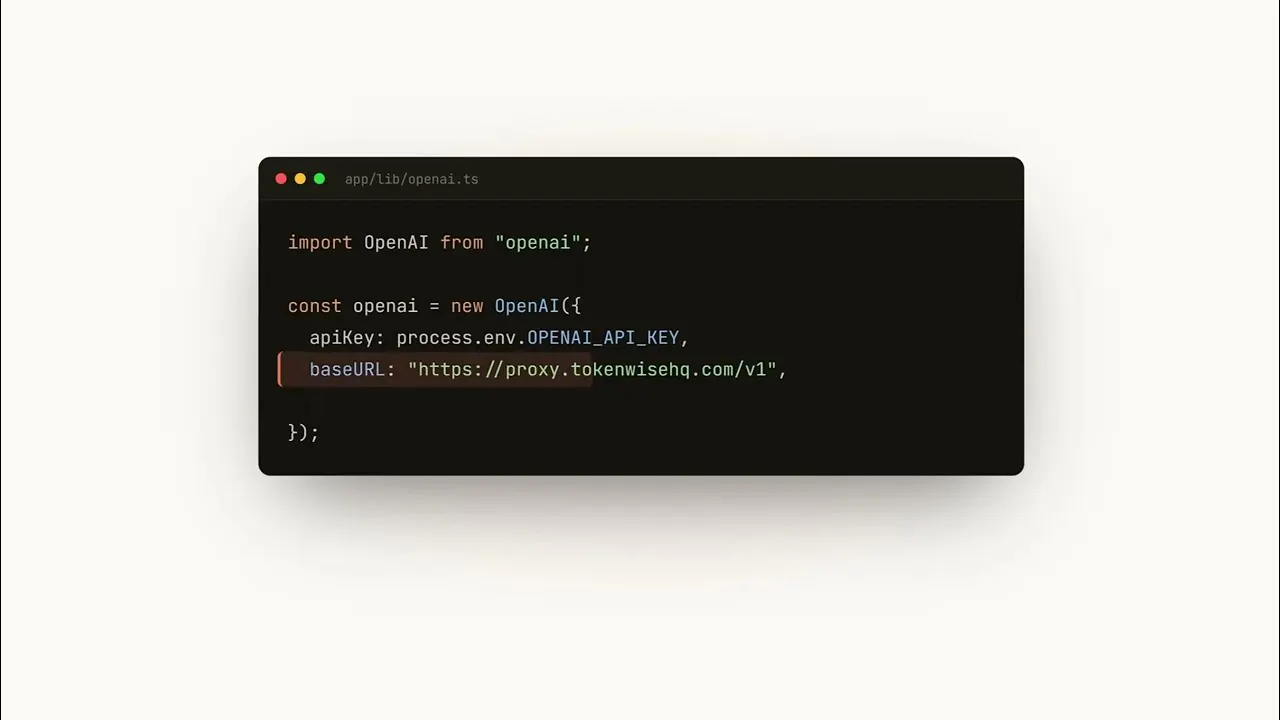
This looks awesome. I use a load balancer but I can probably use that OpenAI key and output to tokenwise but would you ever be interested in developing a built in load balancer for multi-account setups? I imagine there's far more savings to be had if your also load balancing time-based limits but I can also see where it might be out-of-scope for this project and better chained.
-
Gaylord Buckridge 5 months ago
Great idea, I've had the same problem and spent many hours debugging transcripts to look for token savings.
-
Tyrique Lind 5 months ago
The "quality check on your own traffic" angle is genuinely the right frame. I've tried a few LLM cost tools and most just show you aggregate spend with generic benchmark comparisons — which is basically useless when your prompts are domain-specific. One thing I'd love to see: for coding agents specifically, the spend is often bursty and session-based. A 2-hour Claude Code session can easily hit $5-10, but you don't know *which* part of the session burned the tokens. Was it the initial codebase ingestion? A long loop of test-fix retries? Breaking that down by sub-task within a session would be way more actionable than just "session-xyz cost $8.40."
-
Roy Kris 5 months ago
Site is down?
-
Maxwell Blanda 5 months ago
The "quality check on your own traffic, not public benchmarks" is the right frame, that's exactly the gap most LLM-cost tools wave at. Question for Théophile: when you replay a request on the cheaper model to verify quality, how do you score "same answer" without a human in the loop? Embedding similarity tends to be permissive and exact-match too strict.
-
Marcus Macejkovic 5 months ago
Observe-only is probably where I’d start, especially for Claude Code spend. The scary part is the “apply” step. Before swapping a model, does Tokenwise show exactly which traffic it will touch, and is there an easy rollback?
-
Godfrey Donnelly 5 months ago
Does Tokenwise break down coding agent spend by session or only by model?