

Troopr AI Scrum Master
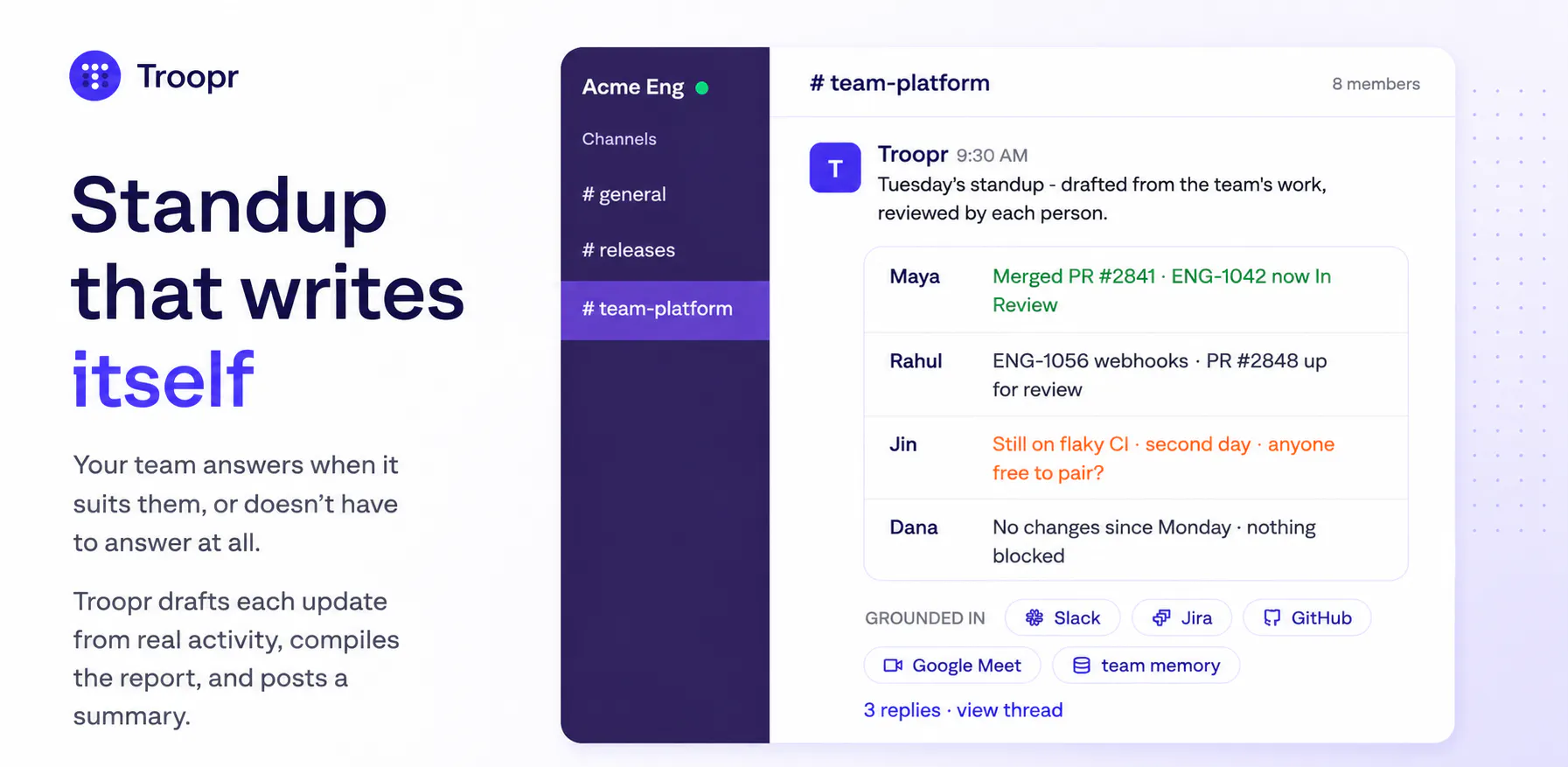
Writes your standup from real work. Remembers your team.
About Troopr AI Scrum Master
Reviews 8
-
Nils Auer 3 months ago
Hi Product Hunt! 👋 I'm Garvit Bandil, Product Manager at Troopr. Here's the problem we kept running into: the true status of an engineering team is scattered across three places that rarely tell the same story. Jira says one thing, GitHub says another, and the real context is buried in Slack. Someone ends up piecing it all together manually, usually during a meeting that's mostly about surfacing work that already happened. That's why we built Troopr. Troopr reads your team's real activity across Jira, GitHub, and Slack, then handles the coordination work for you. It drafts each person's standup including relevant code diffs, so meaningful work doesn't get lost behind vague commit messages. It flags stalled reviews, unresolved blockers, and low-signal updates, and even checks in with quieter teammates before the report is posted. Most importantly, every insight links back to its source: a Jira ticket, pull request, commit, or Slack thread-so you can verify everything yourself. Few more things Humans stay in control. Troopr asks for approval in a DM before making any changes to Jira. Free forever for up to 3 seats. No credit card required. I'll be here in the comments all day, and I'd genuinely love your feedback. Where do you think Troopr would break on your team's workflow? What would you want it to handle better?
-
Orrin Batz 3 months ago
I like that that the retained memory is inspectable instead of being a black box. Congrats team!
-
Marcus Macejkovic 3 months ago
Soumya here from the Troopr Product team 👋 The hardest part of building this honestly wasn't the standups. It was getting the AI to remember the right things without drowning everyone in noise. A team says a hundred things a day, and most of it is clutter. What took the longest was teaching it to hold onto the few that actually matter - the blocker from Tuesday, the call you made last sprint, that risk someone flagged once and everyone forgot about and resurface them right when they matter again. That's what we wanted Troopr to do : remember what the team forgot, and give everyone a clear, honest picture of where things really stand so the whole team stays in sync as the work moves If you run a distributed or async team, I'd really love to know if this resonates.
-
Hobart Glover 3 months ago
Mani here from the Troopr GTM team. Every conversation I've had with an eng lead this year lands in the same place: output is up, visibility is down. Agents ship more, and nobody has a reliable read on what's actually happening. That's the gap we built for, and it's why the memory matters more than the meeting. Curious whether that matches what people here are seeing, or whether it's just the teams that end up talking to us.
-
Murray Kuhlman 3 months ago
Been following Troopr for a while, mostly for the Slack and Jira side of it. Good to see the AI layer land on top of something that already worked rather than showing up as a brand new tool with no track record behind it. Congrats to the team.
-
Michel Heathcote 3 months ago
Siva here 👋 I'm on the engineering team at Troopr, and the best part of building this has been using it with my own team every day. We point it at our daily standup, and every morning it writes each person's update from what they actually did — the PR opened late last night, the ticket that moved, the discussion where someone got unblocked. Most days I read my update and think, "Yep, that's exactly what I did." Nobody has to type a status update anymore. My favorite part is the validation. If a ticket is marked Done but the PR is still open, it catches it. If someone reports the same work for days without any activity in Jira or GitHub, it flags that too. And when there's a real blocker, it doesn't just say "Blocked" — it includes the context and possible next steps. It has no problem calling me out either 😅 For teams that still have live standups, it handles both sides: A pre-read arrives before the meeting, so nobody spends 10 minutes reading updates. During the call, it listens, captures decisions, action items, and owners, then publishes a recap that reflects everything that changed during the discussion. One thing that surprised me is how much it improves over time. It has learned our projects, who owns which services, and even what "blocked" means for our team—without us configuring any of that. The reports today are noticeably better than they were in week one. We've completely stopped preparing for standups. We just show up, skim the report, and spend the meeting discussing the two or three things that actually need attention. If you run an engineering team, try it with just one team for a week. That's the fastest way to understand the value. Happy to answer any questions about how it works under the hood! 🚀
-
Rahul Goyette 3 months ago
Really like the shift from collecting stand ups to actually understanding what's happening across the team. Excited to see where this goes.
-
Ulises Ankunding 3 months ago
Congratulations on the launch! Having an AI that actually understands team patterns and flags discrepancies in updates is a huge step up from standard standup bots.