

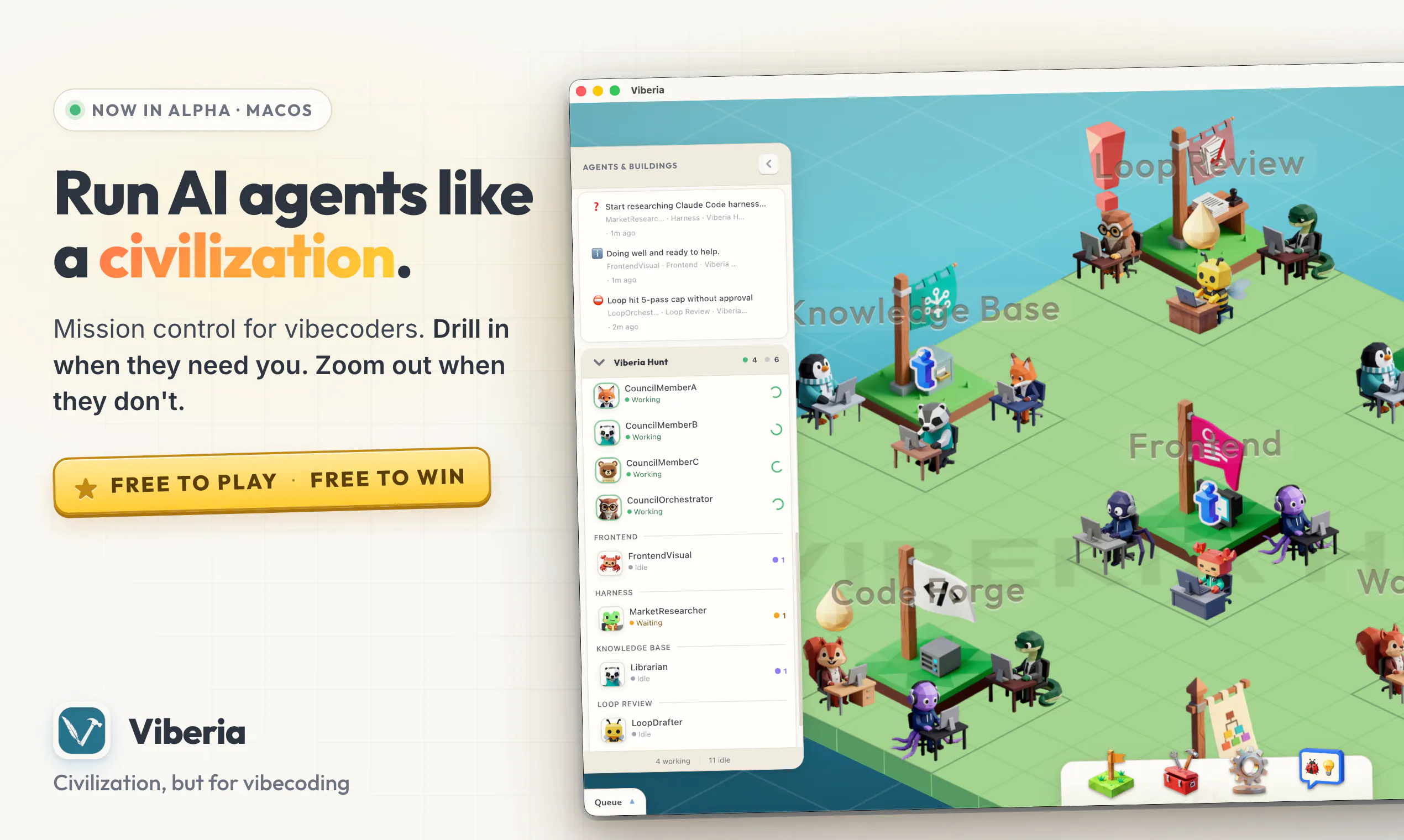
About Viberia
Reviews 11
-
Charley Swift 6 months ago
This is a really interesting approach—turning agent orchestration into something visual and spatial feels way more intuitive than juggling multiple tools. Curious though: how well does context persist across agents over time? Do you still find yourself re-explaining things, or does the system actually reduce that friction? Also really like the idea of treating buildings as task flows—feels flexible without locking users into one structure.
-
Quincy Medhurst 6 months ago
Gamification of tasks that slowly turn mundane is one of my favourite concepts ever and I LOVE what Viberia is doing with it. Most agent workflows right now feel so dead to interact with after a while. Sadly I couldn't try it out right away since I'm not on MacOS, but instantly waitlisted myself. (From the demo itself, the characters got my heart instantly!) The whole commanding-units style approach makes managing workflows less mentally draining for sure. Really rooting for this one!
-
Elmer Schoen 6 months ago
The map metaphor genuinely caught me off guard! I was expecting another terminal-style dashboard. Seeing agent state laid out spatially is a completely different mental model. What I want to know is whether this updates in real time or if there's a delay. When you're managing 10+ agents, a 5-second lag on state changes would make the whole visual pretty unreliable.
-
Merl Orn 6 months ago
agents pick up new skills as they go' line is the one i'd want unpacked. skills in what sense exactly, fine tuning on local context, tool access expanding over time, prompt templates that evolve, something else? that framing could mean something architecturally interesting or it could be a metaphor for agents just getting better context over a session. which one is it and does it persist across sessions or reset when you close the app
-
Burley Collins 6 months ago
pretty cool concept@emre_barut! Curious what are your thoughts regarding visualization/ui/ux for the management of tasks and projects rather than teams and agents? I feel like grooming tasks of different stages (e.g. developing prototypes to get more clarity, or, when enough clarity has been reached, making sure the architecture/plan is good) is a place where bottlenecks are moving into (besides the actual pipeline of how a team of agents handles work) also...pretty fun to see the Lion as the chief/mayor in the pictures, got a bit of zootopia vibes which I thought was lovely
-
Adam Zemlak 6 months ago
This is a great initiative, just wanted to know if you thought of adding an additional feature where different agents remember your codebase and you don’t have to give the context again and again. So my main thought is if we are working on a project so you can divide these agents into teams say frontend, backend team and all the agents works in accordance to each other. If changes are made then all the teams are informed so that every agents works accordingly and there are less coding conflicts. This feature can also save you credits usage.
-
Ayden Miller 6 months ago
Ahah seems so fun, but how do you connect them ? All by one on Claude ? Or another one ?
-
Blaze Koepp 6 months ago
Viberia just got a shoutout in today's daily digest (huge THANK YOU to whoever wrote it!). One thing I want to push back on though: Viberia solves visibility, which is a real problem, but the harder one — agents confidently doing the wrong thing — doesn't get easier with a nicer interface Oh but it does. The agents work with each other, so you can have them review each other's work. Viberia is the interface for chaining agent flows on top of each other, like stacking buildings in Factorio. If they're unsure, they'll pull you in anyway. Yes, today's models aren't 100% reliable at this yet, but if you call multiple models from different providers and have each one give feedback (that's exactly what the Council building is for), your chances of an error drop a lot.
-
Blaze Koepp 6 months ago
Congrats on the launch! The UX metaphor is doing a lot of work hereL 'commanding agents like units' is intuitive in a way that most orchestration UIs completely miss. The real test is whether it scales to non-technical operators who need to run complex workflows without understanding what's happening underneath. Rooting for this.
-
Rylan Cremin 6 months ago
Congrats on the launch, Emre! I am really curious about the architecture under the hood. As these agents collaborate, hand off work, and pick up new skills, is there a knowledge graph getting formed on the backend from each LLM to manage their shared context and relationships?
-
Hobart Glover 6 months ago
really cool idea-feels very different from usual list based tools? Also I am excited to know how you manage it when there are a lot of agents, doesn't it get messy?