

About Waydev Agent
Reviews 8
-
Garnet Stokes 6 months ago
AI tooling budgets are growing but nobody on most teams actually tracks what they're getting out of it. The harder problem is attribution. How does Waydev handle cases where an agent partially completed a task or produced output that needed heavy manual fixing? that's where the ROI math gets messy.
-
Adam West 6 months ago
Love this idea!! feels like every engineering org is asking “are AI tools making us faster?” but most of the answers are still vibes, anecdotes, or inflated productivity claims lol, i have one question tho, just curios: how do you separate real AI impact from already-strong engineers just shipping faster because they were already high performers?
-
Eino Klein 6 months ago
The question you're solving is the one every engineering leader I know is struggling with right now. When I was CTO scaling from 15 to 120 engineers, measuring productivity was already hard enough with human-written code. Now with half the code coming from AI tools, the old metrics are completely broken - lines of code, commit frequency, PR velocity - none of it means what it used to. The conversational approach over dashboards is smart too. The engineering leaders I talk to don't want another dashboard to check; they want answers. How are you handling the signal-to-noise problem when an engineer uses Cursor for boilerplate but does the hard architecture thinking on a whiteboard that never touches the SDLC?
-
Jaylon Deckow 6 months ago
@alex_circei - this is very cool, sorely needed, & looks extraordinarily well designed. With that said… I *ardently* wish you hadn’t chosen to conceal pricing data in the way thay you have. Well, I understand the philosophy, I didn’t tell you that for me it’s an immediate turn off and makes me wary to even engage the platform. Simply: I don’t know if I’m gonna really Waydev, & at the end of seven days, be expected to spend four figures a month, or be locked into an annual contract, or pay some crazy additional amount per seat, or something else that makes this fundamentally untenable for me to use. Again: great work here. This is definitely something special. I just think a little bit of transparency would go a long way. 
-
Kyleigh Luettgen 6 months ago
The "AI Impact" piece is the hardest problem in this space and most tools quietly fudge it. Devs don't write code in clean buckets. They use Cursor to draft, rewrite half by hand, accept Claude's completion on three lines out of fifty, paste a ChatGPT snippet and edit it for an hour. What's Waydev's actual attribution method when AI authorship is partial, mixed, and deniable? IDE-plugin self-reporting, statistical fingerprinting on commits, or something else?
-
Murray Kuhlman 6 months ago
How does Waydev’s AI ROI approach differ from platforms like Jellyfish or Faros that also claim “AI impact/ROI”—specifically in how you model cost (licenses + tokens) against outcomes and how you handle confounders like team mix, project complexity, and seasonality?
-
Esteban Hilpert 6 months ago
This is super relevant right now. Everyone is pouring money into AI, but barely anyone knows what it’s actually returning. Love the shift from dashboards to conversations, feels way more natural for how teams want to work.
-
Merl Orn 6 months ago
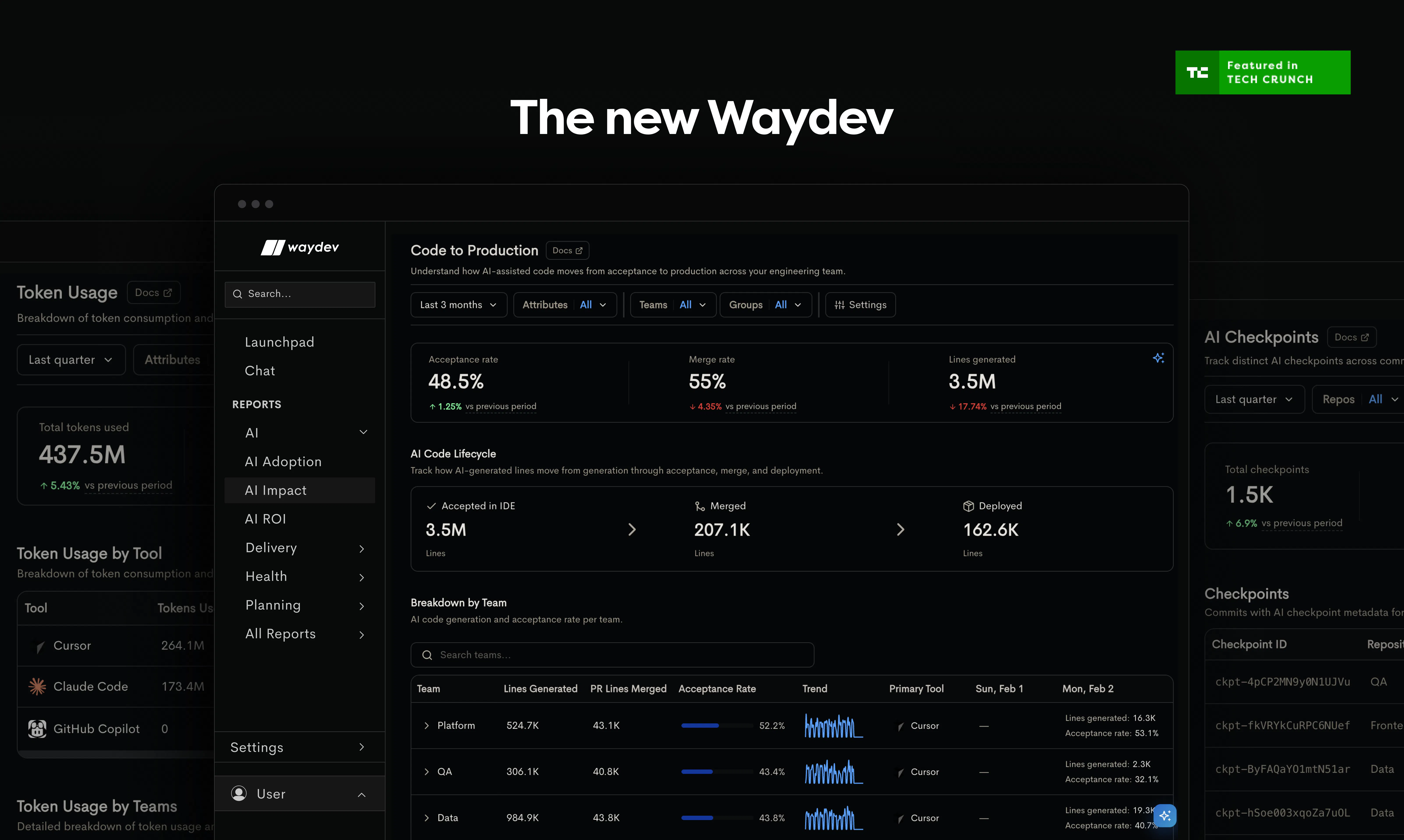
the 'ai adoption vs ai impact vs ai roi' split is the right decomposition. most teams collapse all three into 'are devs using cursor' which tells u nothing about whether the code actually shipped or got reverted. measuring the impact layer is where this gets interesting