

About Weavable
Reviews 15
-
Derick Koelpin 5 months ago
What happens when two agents working the same project write conflicting context? Does Weavable merge it automatically or surface the conflict for a human to resolve?
-
Jedidiah Farrell 5 months ago
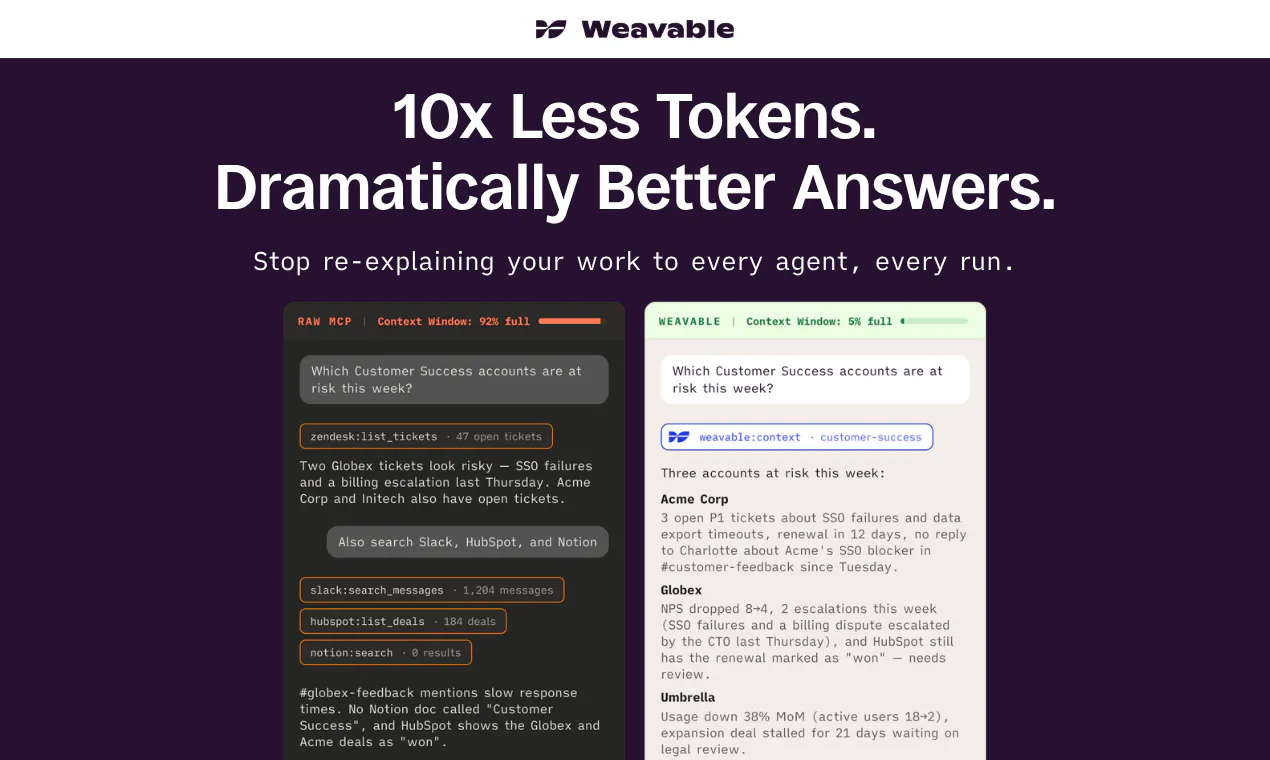
The 1/10th token reduction stat is the one I keep coming back to. Most agent context solutions feel like brute-force data dumps. Maintaining a continuous changelog rather than snapshotting is the right architecture. Curious: how does Weavable handle conflicts when two tools have contradictory data about the same entity, say, Jira marks a task done, but Slack thread says it's still in review?
-
Roy Kris 6 months ago
okay so I've been trying to build a small agent project for college that pulls from Notion and Gmail and the amount of times it just confidently answered something wrong because it was working off old data was genuinely embarrassing 😭 the RAG vs activity graph distinction makes so much more sense to me now and i think RAG is basically a frozen photo while this is more like a live feed, right ? also curious that when an agent queries Weavable mid-task and the context has literally just updated like seconds ago, does it get the new version or could there still be a small lag?
-
Elias Rowe 6 months ago
The shift from static RAG snapshots to a continuous updating changelog for agent context is an interesting move to solve the 'stale data' problem. How does Weavable handle conflict resolution when multiple tools (like HubSpot and Slack) provide contradictory updates to the same shared context layer? I'm also curious if the single MCP endpoint architecture allows for custom logic to prioritize specific 'event types' over others to further protect the agent's context window.
-
Rahul Goyette 6 months ago
Token usage and repeated context loading have honestly been one of the biggest frustrations when working with AI workflows ,so this direction immediately made sense to me. Curious though , how does Weavable handle situations where the same information exists across multiple tools but they contradict each other? Like if HubSpot says a deal is open but a Slack thread suggests it was verbally closed — which source does the agent actually reason from?
-
Elias Rowe 6 months ago
Less flashy than most things in this space but probably more important. Agents keep losing context or reprocessing the same information because there's no real memory layer underneath them. The thing I kept wondering about though is how hard it’ll be to keep that memory clean and trustworthy at scale. If you’re pulling from Slack, Jira, GitHub, HubSpot, etc. in real time, one bad or outdated source could quietly affect decisions before anyone even notices. Anyways, it feels focused on a real bottleneck instead of just adding more autonomy for the sake of it, and I really like that. If agents are actually going to become useful inside companies, they probably need some kind of reliable long-term memory layer like this.
-
Kyleigh Luettgen 6 months ago
The 90% token reduction vs raw mcp calls is a bold claim but the reasoning makes sense , pre-indexing relationships means the agent isn't burning context figuring out that "Acme Inc" in hubspot is the same entity as "acme.com" in stripe. Curious how stale the context layer gets between syncs, especially for workflows that need near-real-time state like live deal updates or ticket escalations.
-
Odell Bode 6 months ago
Sharing context between different agents is probably a lot more difficult in practice than most people think, especially when synchronization and consistency issues arise in distributed systems. I wonder how Weavable deals with rollback or recovery mechanisms if one integration sends the wrong state updates.
-
Al Wolf 6 months ago
The activity-graph approach makes more sense than static RAG or raw MCP calls — context that reflects what changed is fundamentally more useful than a snapshot. Curious how Weavable handles conflicts when the same entity (like a customer) appears differently across Slack, HubSpot, and Zendesk. Does it reconcile automatically or flag it for review?
-
Ayden Miller 6 months ago
Context loss between sessions is so annoying and nobody really talks about it. Every time you start a new agent run you're basically starting from scratch. If this actually solves persistent context across tools, that's genuinely useful. Skeptical but intrigued. Will definitely try it.
-
Hillard Halvorson 6 months ago
Personally, token usage and repeated context loading have been one of the biggest pain points for me while working with AI workflows, so this direction immediately stood out. I really like the idea of persistent work context and reducing unnecessary token overhead while still improving reasoning quality across workflows. One thing I’m curious about is how retrieval quality is maintained for older conversations or long-running contexts. If context is being compressed or optimized for efficiency, how do you ensure important historical information isn’t lost over time when an agent needs to access much older data again?
-
Elmer Schoen 6 months ago
Nice! I loved the activity graph/changelog approach since I was building an escrow platform where the agents need to understand the startup milestones, investor relationships, and payment histories simultaneously. Flooding the context with raw Firestone data was exactly the failure I ran into. Weavable's approach of maintaining a live graph and querying only what's needed is the right mental model I wanted.
-
Elmer Schoen 6 months ago
What interested me most was the activity graph idea. For this kind of problem, it feels a lot more practical than just relying on RAG. A vector database can store snapshots and context, but it doesn’t really capture what actually caused something to change. Like a Slack message from last week might be the thing that moved a deal forward, but a typical RAG setup only knows the message exists, not the impact it had. Tracking what changed, when it changed, and what triggered it feels much closer to how people actually reason about workflows and decisions. One thing I was curious about though is how the graph handles conflicting information across different tools. For example, if HubSpot still shows a deal as open but an email thread suggests it was already verbally closed, how does the system figure out which source to trust?
-
Al Wolf 6 months ago
been tinkering with a lot of mcp lately and love that a product is using a mcp first approach. would definitely love to know more about your approach towards long term context memory over task specific memory. great job guys!
-
Korey Hammes 6 months ago
Why does token usage decrease? Usually, the more memory there is, the more tokens are needed. How did you design this mechanism?