

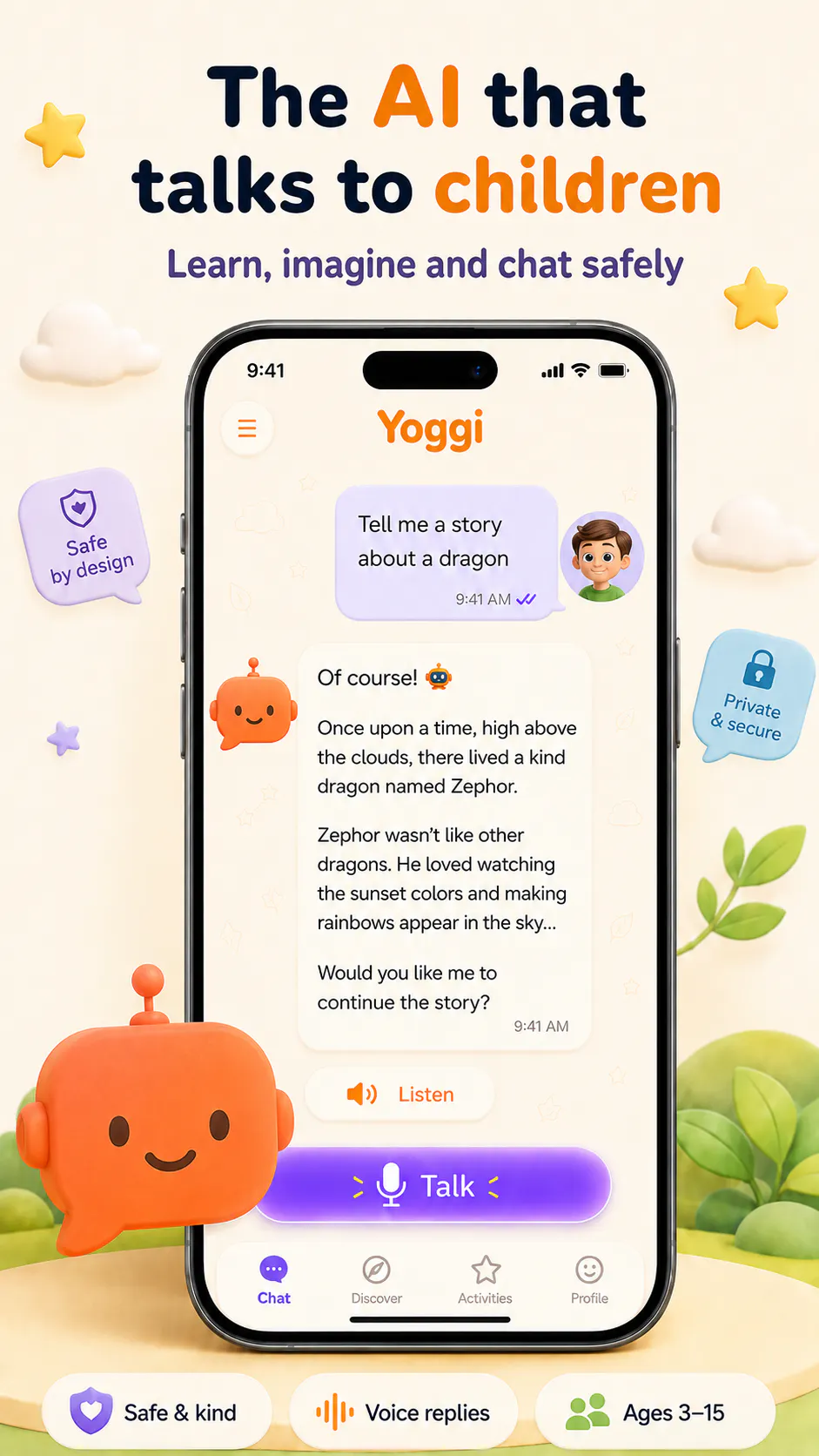
About Yoggi
Reviews 15
-
Malachi Armstrong 3 months ago
You listed divorce as a topic a parent can flag, so it is in the content model but not the account model. There is one Parents' Corner, one PIN, one alert address. Split custody turns that into a choice nobody wants: share the PIN, and each parent can read a mood and topics digest covering the child's time in the other house, or keep it, and one parent sees nothing. Either way the child is the sensor. The families most likely to flag divorce are exactly the ones that lands on, so it seems worth deciding on purpose rather than letting the single-account default decide it.
-
Lance Morar 3 months ago
The daily memory reset is a thoughtful boundary. For the narrower story or learning continuity you’re considering, how would you prevent those saved threads from gradually becoming a profile of the child anyway?
-
Ruben McClure 3 months ago
Congrats on the launch. An AI assistant for children could be genuinely useful, but this is one of those products where the details matter more than the feature list. How does Yoggi adapt its answers between a three-year-old and a fifteen-year-old? That is a huge range in language, judgement and independence. I’d also want to understand what parents can actually see. Is there a useful overview of topics and usage without turning every conversation into surveillance? Getting that balance right feels central to whether children and parents will both trust it.
-
Rupert Emmerich 3 months ago
the chat safety thread here is thorough, but the image generation feature seems like a separate risk surface nobody's asked about yet. text filtering and image filtering are pretty different problems, what stops a kid from prompting for something inappropriate through a drawing request that would never make it past the text filter as a sentence
-
Quincy Medhurst 3 months ago
Lucas, the safety alert layer is the part I would stress test hardest, and it is the one thing in this thread nobody has pushed on. Routing a concerning message to the parent is right for most families and wrong for exactly the families the alert exists for. In the 13 to 15 profiles, the adult being notified is sometimes the reason the child said it. That is why adolescent confidentiality is a separate rule in clinical settings rather than a parental setting, and a detector with one destination has no answer for that case. Is there a second path for the older profiles, where a serious signal can point the child toward an outside resource alongside the parent? Whoever set the threshold that fires an alert made a clinical call, so it is worth treating it as one.
-
Floyd Botsford 3 months ago
That's a thoughtful way to take the feedback - a separate interaction model for the youngest kids rather than just dialing down the same one. Limiting live voice for that age group specifically makes sense to me, since voice is probably what makes it feel most alive. Good luck with the launch.
-
Toni Kutch 3 months ago
Congrats on the launch!
-
Uriah Mayer 3 months ago
I'm intrigued by the age-adapted answers, how do you handle situations where kids might ask sensitive or complex questions that require nuanced responses?
-
Garland Grady 3 months ago
For a young child using voice chat, one question will eventually come: "Yoggi, are you my friend?". How do you handle that kind of question, especially in terms of boundaries? Congrats on the launch!
-
Elmer Schoen 3 months ago
Congrats on the launch! Age-adapting the AI's tone from a 3-year-old to a 15-year-old is a genuinely hard problem, most tools I've seen just pick one register and hope it works for everyone. I'm curious how long a child's conversation transcripts get kept around for the weekly summaries and safety alerts, and who besides the parent can pull up that history once it's stored. That retention detail is the part I'd want spelled out for something built around kids.
-
Johnathan Homenick 3 months ago
the emotional-dependency safeguards you described for teens make sense, but I think the 3-5 end of the range is a different problem, not the same one scaled down. a kid that age doesn't reliably distinguish "talking to a program" from "talking to something alive," especially with voice chat making it feel like a real back-and-forth. is there anything specifically aimed at that youngest bracket to keep reinforcing "this isn't a person," or is the current design tuned more toward the dependency risk that shows up with older kids?
-
Toni Kutch 3 months ago
I've had conversations with parents and they told me that they want for their kids to learn AI without becoming dependent on it. How did you test whether the conversations actually felt natural for children?
-
Kyleigh Luettgen 3 months ago
One thing I'd love to see is a shared family dashboard where parents can review conversation topics their kids explored with Yoggi that week. It would make the parental controls feel less like a black box and help families start real conversations offline based on what their children are curious about.
-
Hazel Altenwerth 3 months ago
hmmmm i am struggling to see the use case of this for kids. Unless its meant to teach kids how to use AI tech so it prepares them for the future.
-
Hazel Altenwerth 3 months ago
Big brother here, and I think this is a genuinely important idea. ChatGPT and Claude can sometimes be too eager to give children the answer they want to hear, and without the right context or boundaries, that can have a negative effect instead of helping them. My 11-year-old sister has just started using AI tools, and I was recently given the task of figuring out how we could limit and supervise that safely. Right now, it can be almost impossible to understand what a child is doing, asking, or being told. Knowledge is a privilege, but access without age-appropriate guidance is not always harmless. I'm really glad I found Yoggi, we'll definitely try it. Rooting for you! :)