

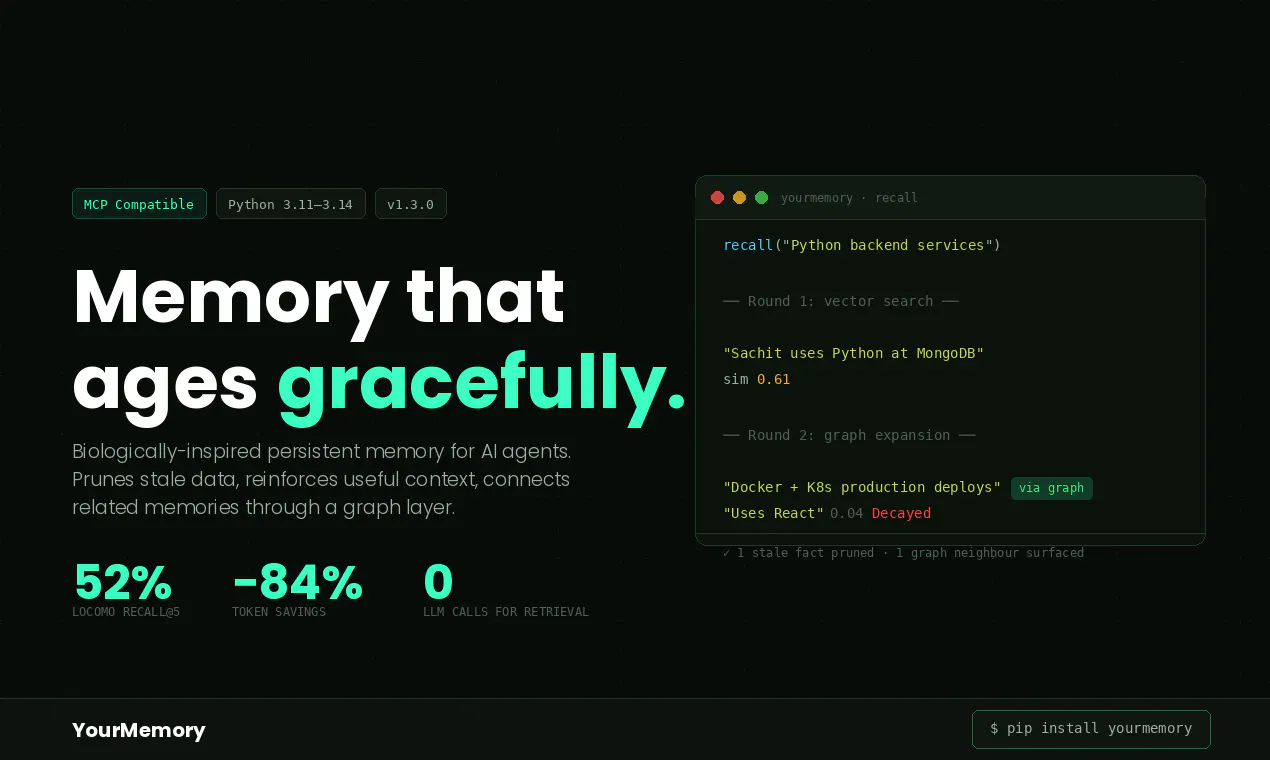
About YourMemory
Reviews 3
-
Jaiden Runolfsson 7 months ago
Self-pruning memory is the right instinct — stale context is what makes most "personalized" AI apps lose their edge over time. I ran into this when building DishRoll (https://dishroll.netlify.app/), a weekly AI meal planner — old preferences (the chicken recipe you loved three months ago that's now boring) kept contaminating suggestions until we added explicit decay and recency weighting. MCP-level memory hygiene is a much cleaner place to solve this than at the app layer. What signals do you use to decide what gets pruned vs. kept?
-
Ayden Miller 7 months ago
Using the Ebbinghaus curve for context decay is a genuinely clever framing. The biggest failure mode I have seen with agent memory is not forgetting too much but forgetting the wrong things. Architectural decisions that were made months ago and rarely referenced can still be load-bearing. Does the graph engine help protect those kinds of low-frequency but high-importance memories from decay?
-
Odell Bode 7 months ago
Ebbinghaus decay plus a graph engine is a clever combination, but the edge case I keep running into is old architectural decisions that are still load bearing. A design choice made six months ago that constrains current code is rarely in active use, so the forgetting curve would drop it, but the graph edges to it are exactly what new code needs. How does the engine decide when decay wins versus when the graph pulls something back into scope?