

About ZeroGPU
Reviews 15
-
Rylan Hyatt 1 week ago
The router part is what I'm curious about. How do you decide a task is safe to send to a small model vs the frontier one? Is it a static rule per task type or does it learn from failures, like when a nano model's classification output looks off? That fallback logic seems like where the real savings are won or lost.
-
Al Wolf 1 month ago
Hey ProductHunt! Sharing an update from our team: our Edge Network is saving 1900x less energy per request than a typical data center AI prompt. ZeroGPU runs AI work on the idle laptops, desktops and phones already switched on around the world. Hybrid inference sends simple, high-volume tasks like classification and summarization to small models on those devices, and keeps complex reasoning on frontier models in the cloud. That lowers cost and reduces AI’s dependence on data centers. Save your frontier model tokens for reasoning and use ZeroGPU for everything else. If you’re ready to start cutting your AI spend, read the full benchmark: https://zerogpu.ai/benchmarks/edge-network
-
Blaze Koepp 1 month ago
In your monetization, am I understanding correctly that you let app developers run inference in their app users? are the users aware they are running inference on their phones?
-
Scotty Feest 4 months ago
Inference costs feel like one of the biggest constraints on AI adoption right now. Curious—does ZeroGPU's biggest advantage come from lowering costs, or from making entirely new workloads economically viable?
-
Haleigh Bartoletti 5 months ago
Product looks really good would love to try! Congrats on the launch 🚀
-
Reilly Thiel 5 months ago
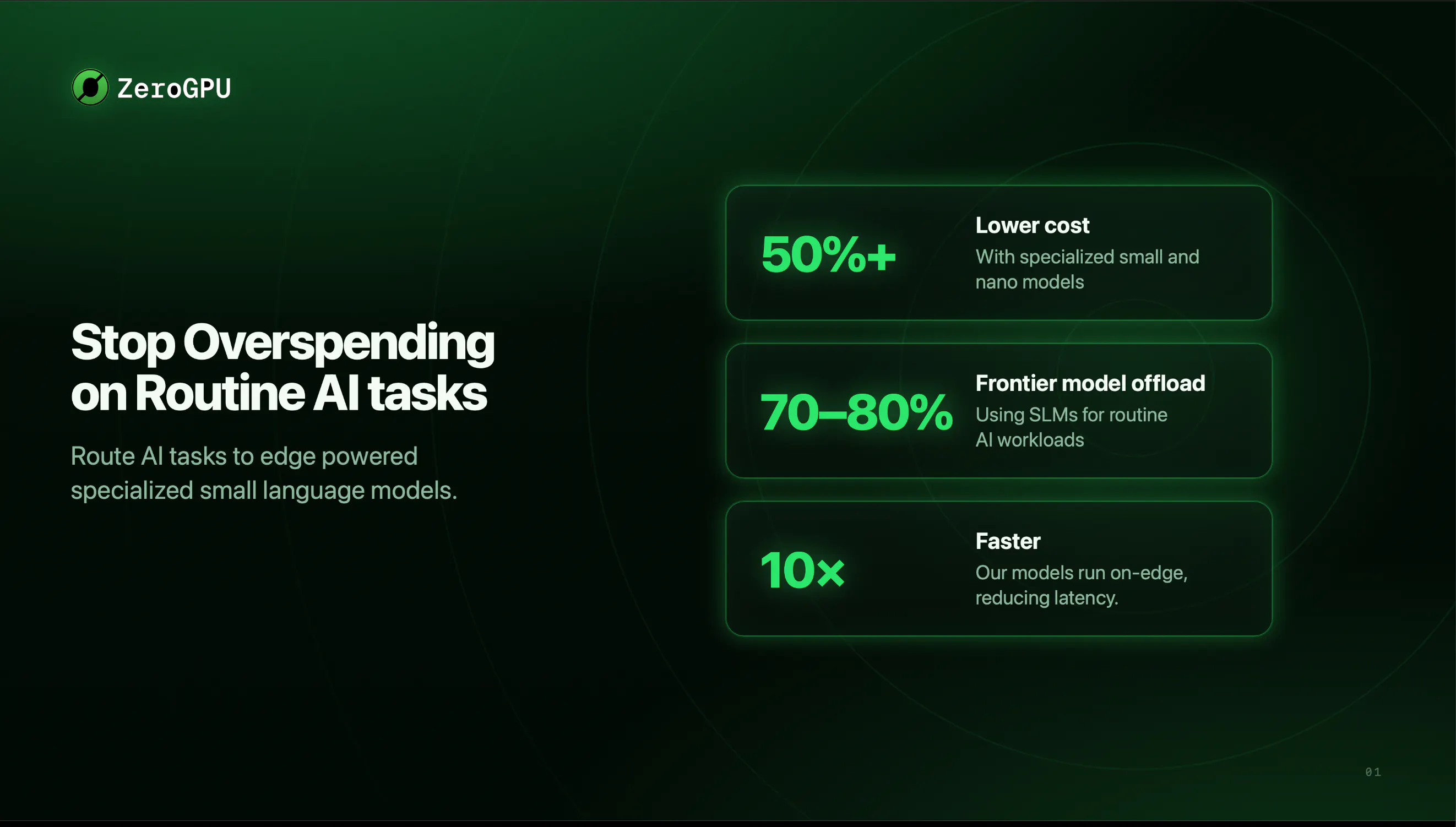
70-80% of production tasks offloaded to small models with frontier-level accuracy is the claim that needs the most unpacking. frontier-level accuracy on which tasks specifically. small models are genuinely competitive on classification, extraction, and summarization of well-structured inputs. they fall apart on complex reasoning, ambiguous instructions, and long-context tasks. curious what the task routing logic looks like and how you're deciding which tasks go to small models versus when you escalate to a larger one
-
Adam Zemlak 5 months ago
Running specialized SLMs on the edge is a smart approach. The 10x speed boost is huge for keeping latency down. Quick question on the infrastructure side, how do you guys keep uptime and latency stable if you're pulling from a hybrid network of shared compute?
-
Neal Jacobson 5 months ago
This is a mine gold! What support is there for embedded vision models, or tiny tasks like RAGs embedding?
-
Jedidiah Farrell 5 months ago
Strong thesis, and it matches what I hit building in the wild. Most of my pipeline was never reasoning, it was "classify this comment into one of 7 stances" running hundreds of times per video. I prototyped it on an LLM (slow, per-call cost, single point of failure), then distilled it into a fine-tuned multilingual model exported to ONNX - cheap CPU box, deterministic, no API bill. Shipped it as PJQ (pjq.life). So your "80% of inference is routine, not reasoning" point isn't a forecast for me, it's already in prod. Curious where you draw the line between hosting a small model for the user vs someone bringing a task-specific fine-tune like mine - is the catalog fixed, or is BYO-model first-class?
-
Conner Jacobs 5 months ago
At Dappier, we've been using ZeroGPU in production for several weeks, specifically for a set of classification tasks. It has helped us reduce latency on these tasks vs general purpose LLMs by at least 10x. This latency reduction has helped us to reduce not only our LLM costs significantly but also associated cloud costs that are reliant on the task results.
-
Adam Zemlak 5 months ago
Hot take - most teams won't admit: 80% of your AI calls aren't reasoning, they're "classify this / moderate that" running a thousand times an hour. Paying frontier prices simply cant be sustainable Point your boring workloads at this and stop bleeding. Congrats on the launch 🚀 @its_maddy_a
-
Chelsey Gottlieb 5 months ago
The pay-for-efficiency angle is refreshing when most platforms just bill raw GPU-hours. Curious how you handle cold starts on the serverless layer — that's usually where the "compute-efficient" promise breaks for spiky workloads.
-
Paul Kshlerin 5 months ago
I feel like a lot of AI apps are probably overusing expensive models by default. Did anything in your benchmark results surprise you?
-
Tyrique Lind 5 months ago
The name is 'ZeroGPU' but you mention cloud fallback — so there are still GPUs somewhere. Is the name aspirational, or is there genuinely no GPU in the path for most calls? Curious what the architecture actually looks like.
-
Jarrell Homenick 5 months ago
Been dealing with inference costs creeping up on us for months. We route classification and extraction at volume - things that don't need GPT-5 level reasoning but we've been sending them to frontier models anyway because the setup friction for smaller models wasn't worth it. The OpenAI-compatible API is what makes this actually actionable rather than just interesting. The Dappier numbers are hard to ignore - 6x cost reduction at that latency improvement is real signal. Adding this to the test queue this week.