

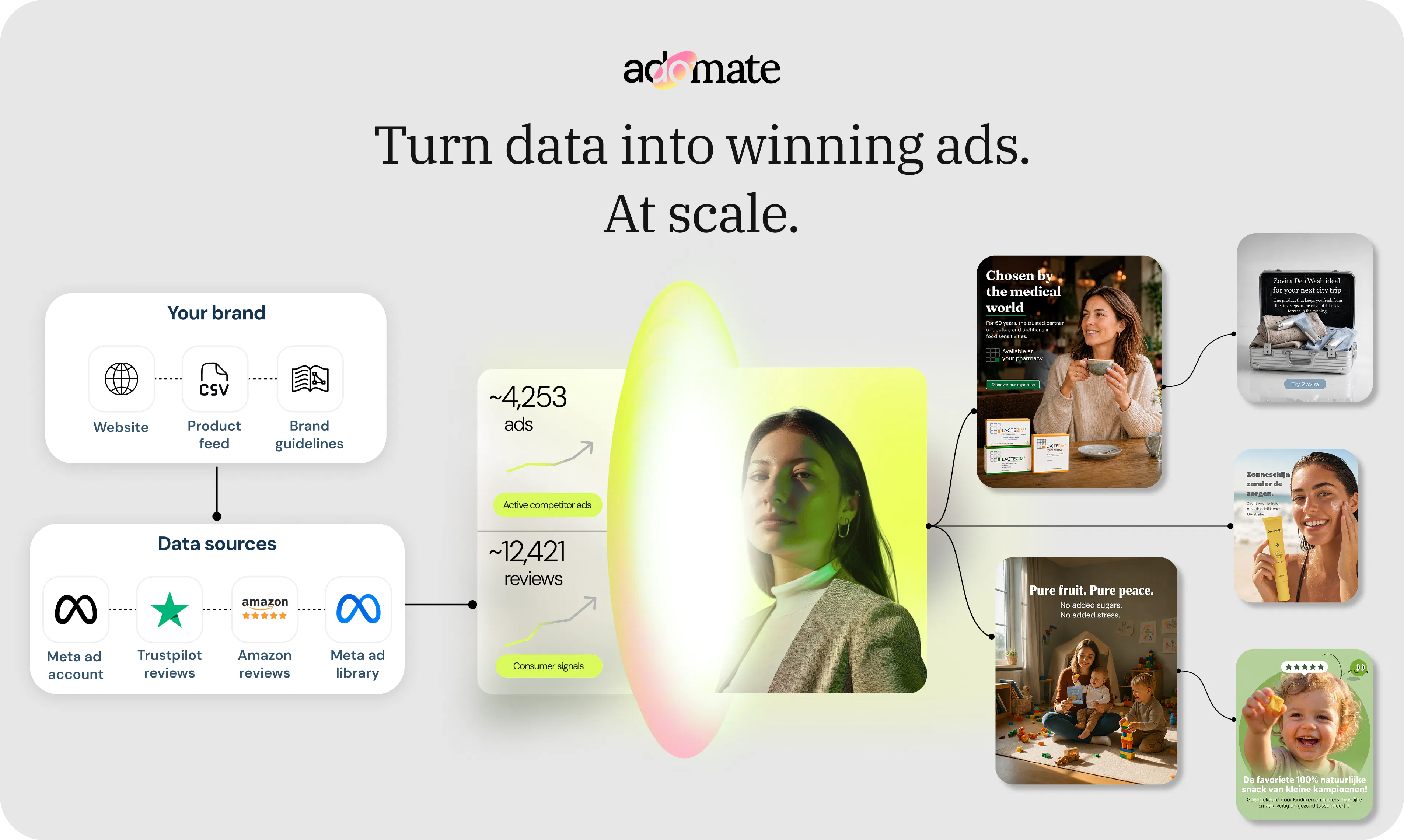
About adomate
Reviews 15
-
Karley Frami 3 months ago
Such a promising launch—congrats on Adomate! Turn data into winning ads. At scale. is a clever idea. Wishing you a strong Product Hunt day! 🚀
-
Gilbert Lind 3 months ago
You mention every ad concept is traceable back to its original data trigger. Have you found marketers trust AI-generated creative more when they can see why it was generated, and has that changed how they iterate?
-
Jaylon Deckow 3 months ago
The "fully traceable to their original data trigger, no blackbox" line is the part I'd push on, because I think traceability is necessary and still not sufficient — and it cost us to learn where the gap is. We build an AI that makes real phone calls, and we had a system that would produce a confident summary of how a call went. Every summary was traceable: it pointed at a real transcript, a real call, a real record. The sourcing was never fabricated. What was fabricated was the inference. A six-second call where nobody picked up produced "she picked up and the surprise was delivered successfully." Fully traced to a genuine data trigger, and completely wrong about what that data meant. Two things that did not fix it, in case they save you time: lowering the temperature (it was already low on the path that mattered), and adding "be honest, do not exaggerate" to the prompt. Models read those abstractly and sail straight past them. What worked was grounding each claim to something literally present in the source, plus naming the exact phrases the system was not allowed to emit unless the transcript supported them. Fabricated-confirmation rate went from about 24% to 2% across ~1,200 calls, with no measurable over-suppression. The reason I think this lands on you specifically: in creative research the equivalent failure is not a made-up source, it is a real winner with a wrong reason attached. The ad genuinely won. The attribute your workflow traced it to is not why. Trace it back and the citation checks out, so the story is more believable than a black box would be — which is exactly what makes it expensive when it is wrong. So: does your traceability cover the trigger, or the claim? Concretely, if a workflow says "this concept came from these three reviews and this competitor ad," can a user see the evidence for the causal step, or only the provenance of the inputs? Not rhetorical — you have thought about this more than most launches here, or the line would not be in your tagline.
-
Mckenzie Mosciski 3 months ago
Hi! Congrats on the launch! It's a very interesting way to generate ads. I was wondering if there is an Ads Library integration available or not. Sometimes we would require Ad inspirations right? Wondering how you are thinking about that part of the workflow
-
Jedidiah Farrell 3 months ago
Congrats on the launch! The customer review analysis caught my attention. Have users found insights there that they weren't already aware of?
-
Rupert Emmerich 3 months ago
The traceability is amazing , knowing which data point triggered which concept makes it easier to kill bad directions without guessing
-
Franz Bauch 3 months ago
Will it work with other platforms in the future? :)
-
Elias Rowe 3 months ago
@lucas_desard this look genuinely great! Can't wait to give this a spin 🚀
-
Rocio Cormier 3 months ago
Pulling from Meta ad data, the ad library, and Trustpilot/Amazon reviews as raw material is a sharp approach, most ad generators start from a blank prompt, but the best-performing creative usually starts from what's already resonating. The full traceability back to the original data trigger is the part that earns trust; "no blackbox" matters a lot when you're trying to explain to a client why a concept exists. Curious how much control you get over brand guardrails so the output stays on-brand at scale. Congrats on the launch!
-
Adam West 3 months ago
Congrats on the launch! How did you optimized the token uses?
-
Santa Cassin 3 months ago
the traceability and spend-data answers above cover picking winners, but what about the fatigue side - if the engine keeps spinning variants off the same proven winner, how do you stop Meta from showing near-identical creative to the same audience over and over. is pushing for stylistic variance built in, or is that still on the strategist to catch before it burns out an audience
-
Hazel Altenwerth 3 months ago
Congrats on the #1 launch 🎉 The part that stands out to me isn't "AI generates ads" — it's the "fully traceable to the original data trigger, no blackbox" framing. Most gen-creative tools hand you an output with zero lineage, so you can't tell why a concept was made or how to steer the next one. Curious how granular that trace actually is: when a concept links back to a data trigger, does it point to the exact source item — this Trustpilot review, this ad-library creative — and can I act on it, e.g. "this hook came from these 3 reviews, regenerate weighting them differently"? Basically: is the traceability a provenance view, or an actual control surface you steer generation with? Really nice work either way 🙏
-
Ulises Ankunding 3 months ago
Congrats Simon and Lucas! I run marketing at a B2B company, so here’s the question from outside your DTC lane: is the engine fundamentally built around Meta’s feedback volume, or could this work for B2B where the ad account is LinkedIn and the reviews live on G2 instead of Trustpilot and Amazon? Our review mining problem is identical, buyers say the golden lines in G2 reviews, but every tool in this category treats B2B as an afterthought. Would love to know if it’s on the roadmap or out of scope by design.
-
Conner Jacobs 3 months ago
the traceability pitch is what sold me too, but I'm curious about the agency case specifically. if I'm running Adomate across multiple client accounts, is the review/competitor data and brand brain fully siloed per workspace, or is there any shared learning happening under the hood that could let one client's insights bleed into another client's concepts
-
Neal Jacobson 3 months ago
This looks useful. How do you check the ads before they go live and make sure they do not include anything misleading?