

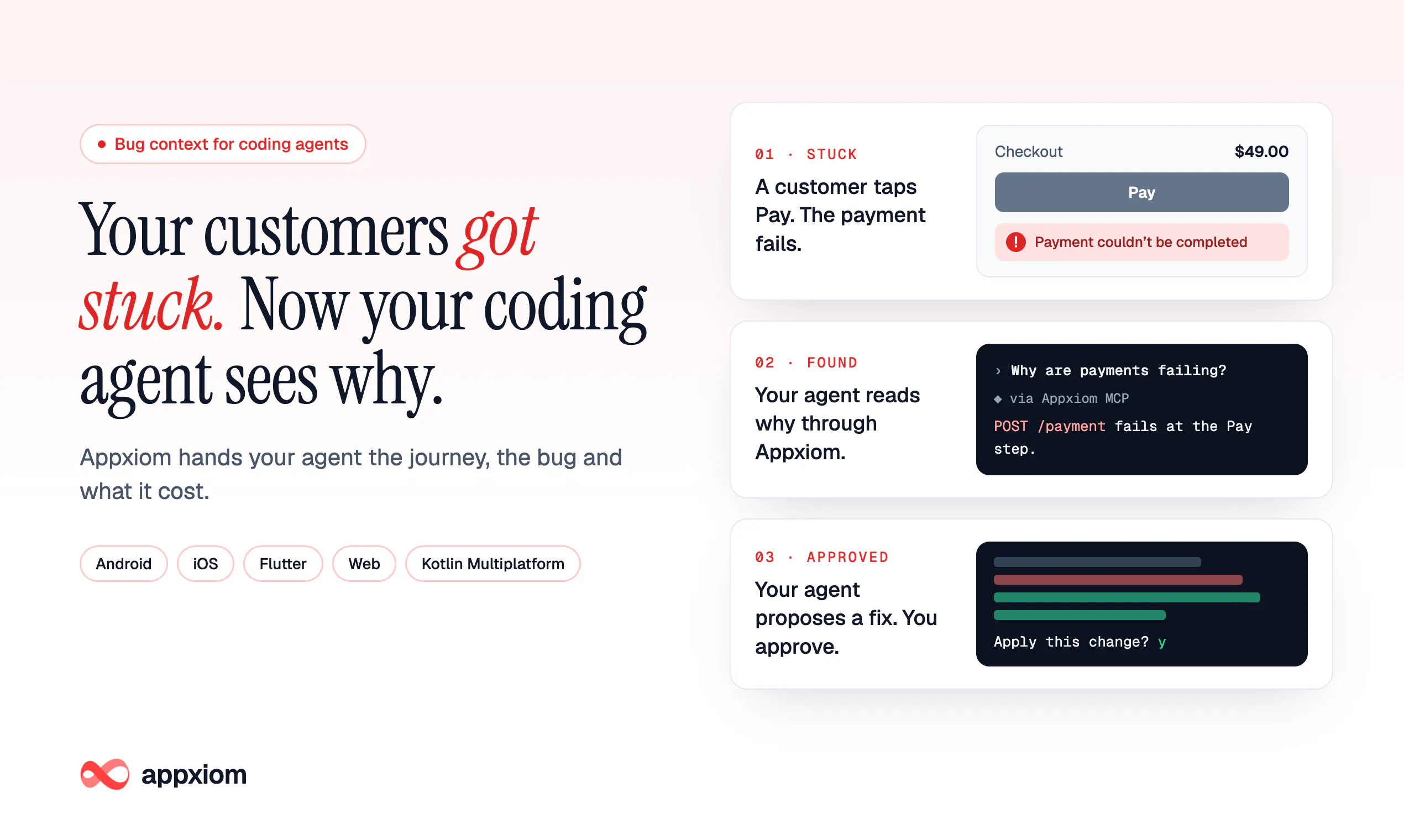
About Appxiom
Reviews 15
-
Nils Auer 2 days ago
Giving coding agents production crashes, failed network calls, and user journey context through MCP is a useful approach. Can Appxiom automatically group related failures across different app versions so agents investigate one root cause instead of creating multiple fixes?
-
Santa Cassin 5 days ago
How does the agent actually pull the data, MCP server or something it reads from the repo? I sometimes have Claude Code and Codex open on the same app and I can already see both of them going after the same crash.
-
Joany Hansen 1 week ago
Congratulations on the launch 🚀 @robin_a_p
-
Joshua Abshire 1 week ago
Congrats @andrea_sunny How does it decide which production issue is important enough to send to the coding agent first?
-
Jarrell Homenick 1 week ago
I was just trying out Sentry, and honestly, reproducing the errors behind an alert always takes forever. That's why "Device Data" and "Device Runtime State" are my favorite parts of the demo. Congrats on the launch! 🎉
-
Felipe Sanford 1 week ago
Giving coding agents production context through MCP is a useful way to improve debugging. Can Appxiom correlate a failed user journey with the exact backend API error across multiple services, rather than only showing the frontend symptoms?
-
Zachariah Hudson 1 week ago
Nice one, Robin. When Shopify support arrives, will checkout show up as a goal automatically, or will you still mark it yourself?
-
Floyd Botsford 1 week ago
This is an interesting direction. Coding agents need production context to go beyond writing code and actually help fix what breaks. Congrats on the launch!
-
Lance Morar 1 week ago
This is the missing piece for me — my coding agent can read the whole repo but knows nothing about what actually breaks in production, so it ends up guessing from a stack trace alone. What I'd want it to see first is the exact steps a user took right before the crash — the taps and screens that led there — because that's usually what decides whether a fix is even reproducible. And I like that GFI ranks by the goal a bug blocks rather than raw crash count; as a solo dev I can't chase every crash, just the ones stopping people. Congrats on the launch!
-
Neal Jacobson 1 week ago
@robin_a_p congrats on the launch! When the agent pulls raw user journey data over MCP, is any PII masked before it reaches the agent? My guess is a lot of teams wont want user emails or IDs going into an LLM context. Also where does the context data live, in short where is it deployed and what data is used for model training?
-
Joany Hansen 1 week ago
Looks interesting! Huge congrats to the team! Can the agent see which app version an issue started in?
-
Mike VonRueden 1 week ago
The GFI part is interesting. App bugs can quietly cost conversion, and leaving marketers wondering why users are dropping off. Connecting those bugs with drop-offs is very cool.
-
Rahul Goyette 1 week ago
Right gap to solve for and the decision to stop at providing context and not providing the actual fix is the right thing to do. Let coding agent take control of that with this additional context.
-
Marcelo Prohaska 1 week ago
linking failed signups and checkouts back to the bug behind them is a neat angle. congrats Robin!
-
Fidel Davis 1 week ago
Connecting a bug to the signup or checkout it interrupted gives an agent a more useful starting point than a stack trace alone. I also appreciate the clear boundary between supplying that context and deciding what the fix should be.