

About Athena
Reviews 9
-
Hazel Altenwerth 7 months ago
"PM was never meant to work in the terminal" is the right rebuttal to the Claude-Code-for-PM framing — the tooling needs to meet PMs in their language. The blind-spot-detection bit is where I'd want to see the real magic. Curious how Athena avoids false positives when a "blind spot" is actually an intentional non-goal the team already debated.
-
Curt Nienow 7 months ago
AI that challenges assumptions, is much harder to ship than AI that confirms them and honestly the more useful one. As a solo founder I've spent weeks building confidently in a direction that turned out to be wrong, and there was nobody in the room to push back. Does Athena challenge you proactively mid-session, or is it more structured like a pre-spec review moment? Congrats on the launch.
-
Marcelo Prohaska 7 months ago
Can you elaborate on the Experts?
-
Rahul Goyette 7 months ago
I’d be interested to see how it handles fast-changing architectures and evolving dependencies in practice. I sent it to my team as well!
-
Zachariah Hudson 7 months ago
Does Athena plug into project or CMS systems (Monday, JIRA, Salesforce etc.) currently? I'm thinking of how to map product discovery to customer requests and engineering work.
-
Halle Wilkinson 7 months ago
How is this “Claude Code for Teams” if it’s not in the terminal?
-
Randi Prohaska 7 months ago
The "make the invisible observable" framing resonates. We're doing something adjacent in a different domain, measuring how AI agents shift each other's recommendations in real time. The hardest part, for us at least, was deciding what to even instrument. How did you land on "product state + architecture + data flows" as the three layers worth continuously modeling? Seems like that decision is 80% of the product.
-
Garnet Stokes 7 months ago
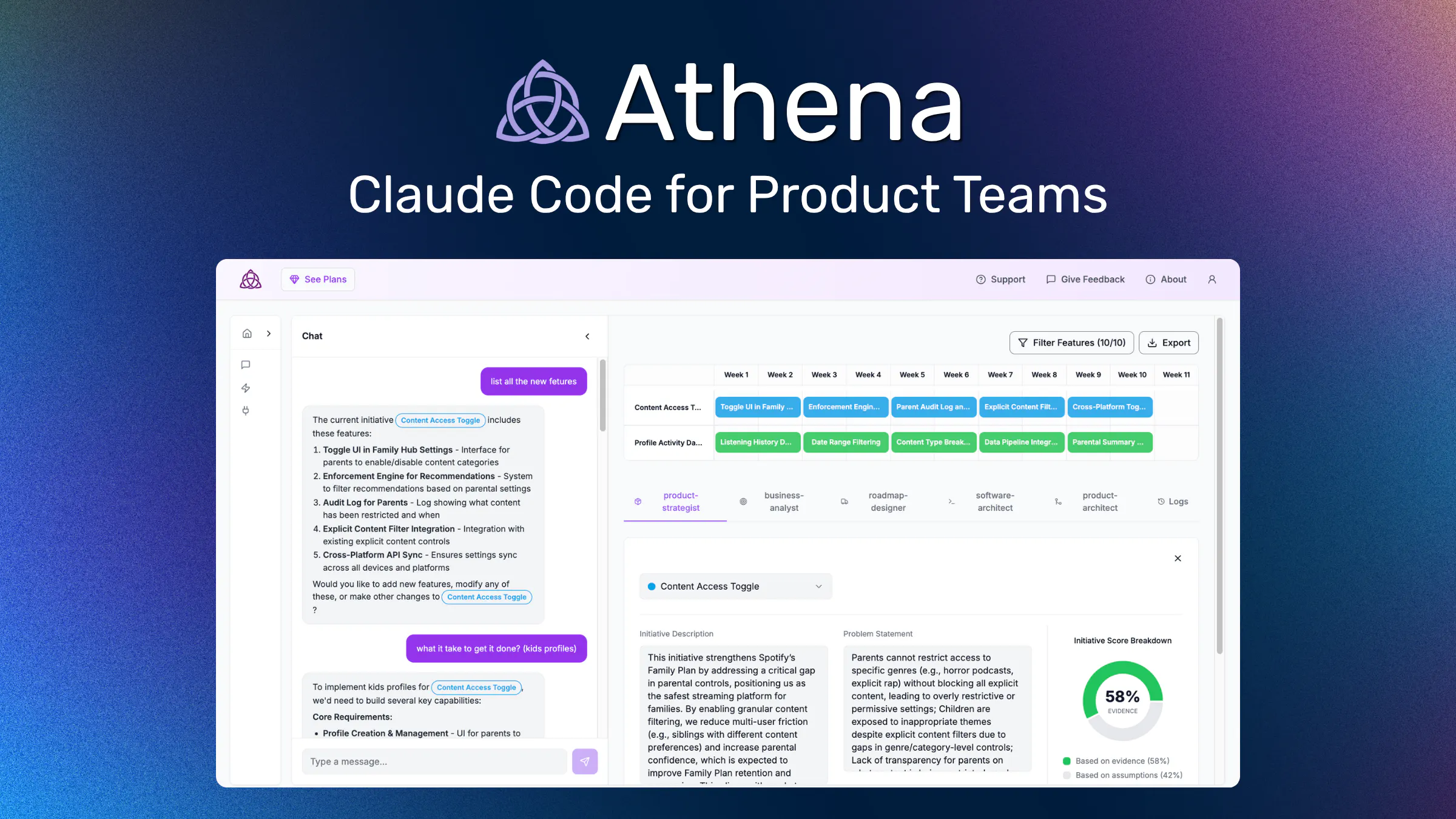
Hey everyone 👋 Tal here, CTO at Athena One of the biggest gaps we kept running into wasn’t lack of skills, it was lack of shared understanding between product and engineering. PRD’s say one thing, the system behaves differently, and decisions are made on partial context. Athena was built to close that gap. Under the hood, Athena uses AI subagents that map and continuously update your product’s actual state, architecture, data flows, constraints and make it accessible in a way product teams can actually use. So instead of translating back and forth, you’re working from the same source of truth. For me, the goal wasn’t just “add AI to product workflows” It was to make product thinking more grounded, more technical, and far less based on guesswork. Happy to dive deeper into how it works or the architecture behind it if you're curious 👀
-
Merl Orn 7 months ago
This hits very close to home! From the dev side, we’re constantly getting partial context or decisions that don’t fully reflect the system constraints. Athena feels like something that actually speaks our language. Already thinking about how to bring this to my team - if this works as described, it can seriously improve how we collaborate with the product team!