

About GamerForge
Reviews 4
-
Joaquin Wisozk 5 months ago
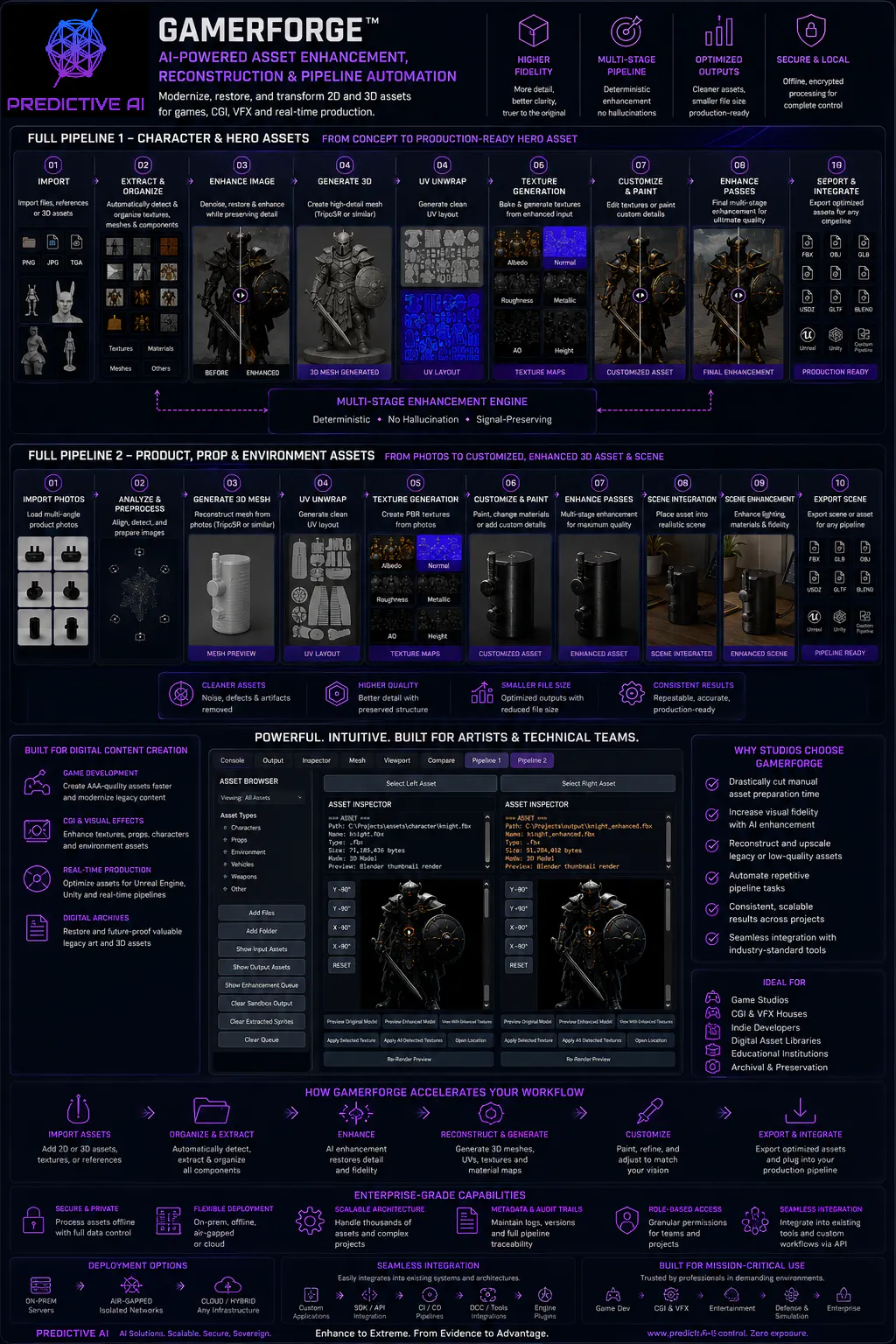
In the current AI-driven era, most image platforms are designed for general creativity; they’re great for concept art or sparking ideas, but they often fall short when it comes to the technical rigors of game development or 3D production. GamerForge flips this script by moving away from just “generating pixels” to solving actual pipeline problems. Here is why it stands out as a more valuable tool for professionals: It’s a Workflow Multiplier, Not Just a Generator: While general AI tools often produce assets that need heavy manual cleanup, GamerForge is built to handle the heavy lifting of modern production pipelines, like upscaling textures, extracting sprite sheets, and generating the maps required for Unreal, Unity, and Blender. It Unlocks Hidden Value in Old Libraries: Most studios are sitting on goldmines of legacy assets. GamerForge makes it possible to modernize and restore these older files, turning outdated content into high-fidelity, production-ready assets without having to build them from scratch. It Speaks the Language of 3D: General AI platforms struggle with structural integrity; GamerForge understands the formats that actually matter for developers, including FBX, OBJ, and GLB. It treats your work as a digital asset rather than just an image. It Prioritizes Speed Over Manual Labor: By automating the most tedious parts of asset prep—like creating material maps or cleaning up photogrammetry outputs—it gives time back to the artists to focus on the creative vision rather than repetitive, manual tasks. Ultimately, GamerForge feels more “human” to a professional team because it respects the constraints and technical realities of building a game or a film, whereas most AI tools are just trying to impress you with a pretty picture.
-
Demetrius Gulgowski 5 months ago
This is absolutely gonna accelerate the workflow of game developers
-
Eino Klein 5 months ago
This demo walks through one of the workflows that GamerForge enables. In the video, we take a 3D asset, extract its textures, process those textures through our AI enhancement pipeline, and then reintegrate the enhanced textures back into the model itself. What makes this particularly interesting is what happens next. Once the model has been enhanced, GamerForge can export an image of the entire rendered scene containing that enhanced asset. That exported scene is then treated as a standard image and can be processed through the enhancement pipeline again. In other words: Model → Texture Enhancement → Reintegrated Enhanced Model → Scene Export → Scene Enhancement This allows both the underlying asset and the final rendered output to benefit from enhancement. During development, we found that this workflow could produce additional visual improvements without the types of artifact accumulation or quality degradation that are often associated with repeatedly processing already-enhanced content. The same technology can operate across textures, standard images, sprites, standard images, 3D models, and exported scenes, allowing creators to move between asset-level enhancement and scene-level enhancement within a single workflow. Happy to answer any questions about the technology, workflow, or roadmap.
-
Mortimer Powlowski 5 months ago
What makes GamingForge different is its focus on the practical side of production. Creative teams often spend more time than they would like preparing, organizing, repairing, and adapting assets for new projects. By reducing that workload, it gives artists, developers, and production teams more room to focus on the creative decisions that actually shape the final result. It is built around a simple belief: work that took time, skill, and care to create shouldn't be discarded just because technology has moved on. Instead of asking teams to start from scratch, it helps them bring older assets back into modern workflows, making them easier to use while preserving what made them worthwhile in the first place. Every digital world carries a piece of the people who created it. A texture refined over countless hours, a model adjusted again and again until it felt right, an environment shaped long before players or audiences ever saw it. As tools and production pipelines evolve, many of these assets are left behind, not because they no longer have value, but because they become harder to work with. Projects that once represented months of effort can slowly fade into archives, waiting for a way back. At its heart, GamingForge is about making sure valuable work continues to have a place. Instead of letting years of effort sit untouched in old libraries and storage drives, it helps teams restore, improve, and reuse what they already have. In an industry that changes constantly, there is something quietly valuable about being able to carry good work forward rather than leaving it behind.