

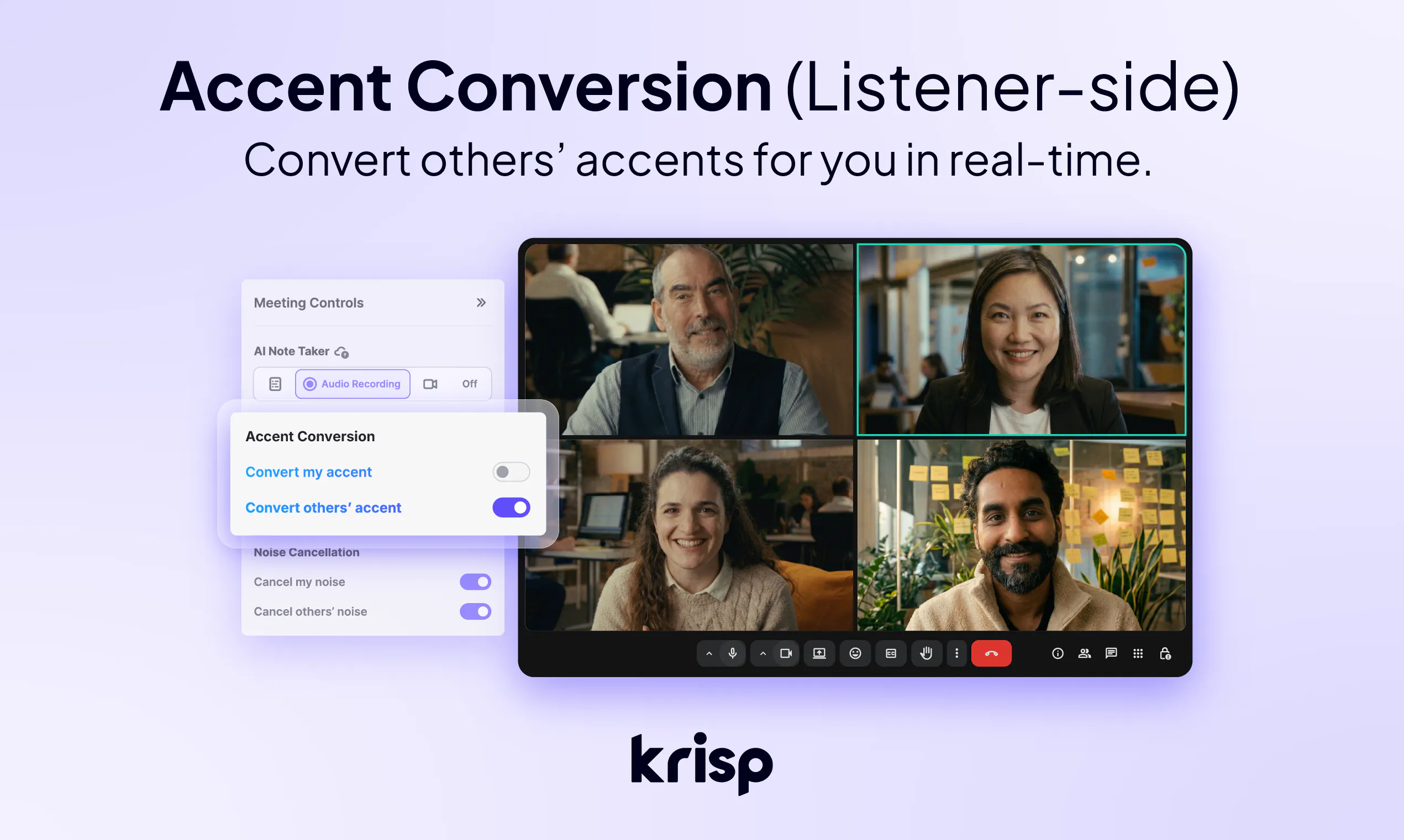
About Krisp Accent Conversion
Reviews 15
-
Korey Hammes 5 months ago
Most AI meeting tools focus only on summaries, but Krisp seems to focus on communication quality itself. Real-time accent conversion + clean audio can genuinely reduce fatigue and misunderstandings in remote meetings. Curious how far the conversational turn-taking models can scale in production environments.
-
Reilly Thiel 7 months ago
Real-time accent conversion sounds like sci-fi but also… super useful. meetings with international teams would be way less painful tbh but first things first - we gotta roll this out at Tim Hortons drive-thru asap :D half the time I’m like “sorry??” 3 times before I even order coffee if this works smoothly in real conditions, this could be huuuuuge
-
Joaquin Wisozk 8 months ago
Real-time accent conversion is a massive unlock for global teams. The accented speech problem isn't just about clarity, it's about the cognitive load on listeners, which affects meeting productivity. How does it handle code-switching, like when someone moves between their native language and English mid sentence? And is the conversion noticeable to the speaker themselves, or is it fully transparent?
-
Malachi Armstrong 8 months ago
Running accent conversion on the listener side is such a thoughtful design choice. The speaker does not have to change anything or install extra software - they just talk naturally. With 1.1B ESL speakers globally and remote teams becoming the default, this solves a real communication friction point. The fact that it is fully on-device with near-zero latency means it can work in live conversations without that awkward delay. Really clever application of voice AI beyond just noise cancellation.
-
Paul Kshlerin 8 months ago
The accent conversion feature is the one that stands out to me that's a genuinely hard problem and if it works well in real time it could be transformative for global teams where communication friction from accents causes real misunderstandings. Curious how it handles edge cases like someone switching between languages mid-sentence or strong regional accents within the same language like Scottish English versus American English. Also the no meeting bots angle is the right call nobody wants a robot joining their call and making everyone self conscious. How does the transcription accuracy hold up in a meeting with five or six people talking over each other?
-
Adam West 8 months ago
Will this also work for my college lectures? cause if it will this could be a game changer! also its a great looking product so you totally earned the upvote and follow.
-
Jedidiah Farrell 8 months ago
Running this on the listener side is a smart design choice. The speaker doesn't have to install anything or feel like they're being "corrected," which would kill adoption immediately. One thing I'm wondering about: does the conversion affect the emotional register of speech? Accents carry a lot of tonal information beyond just phonemes. If someone is frustrated or excited, does that come through the conversion intact? The call center use case makes a lot of sense. Reducing repetition ("sorry, can you say that again?") probably does more for customer satisfaction than any script optimization.
-
Carter Volkman 8 months ago
Game changer for international teams. Call center SaaS is a competitive ad market — how are you positioning against the noise?
-
Adam West 8 months ago
Listener-side is the right call here. Making adaptation happen on the receiver rather than forcing speakers to modify their voice is both more ethical and more practical at scale. The SDK angle for embedding this directly into voice AI agents is what makes this genuinely new territory like not just a meeting tool upgrade. How are you thinking about measuring comprehension improvements in voice agent deployments specifically ie whether accent-related recognition errors drop, or is that still mostly a human-reported metric?
-
Floyd Botsford 8 months ago
This has been a long build. Accent Conversion is one of the most practical features we’ve shipped. Thanks for checking it out.
-
Jake Blanda 8 months ago
This is a really clever approach - solving it on the listener side instead of asking the speaker to change is such a smart product decision. We work with people from all over the world and the "smile and nod" moment is too real. Curious about one thing - does this work well in group calls with multiple accents at once, like a meeting with 5 people from different countries? Or does it work best when it's mainly one speaker at a time?
-
Garland Grady 8 months ago
Congratulations on the launch! It’s truly amazing that it can achieve real-time accent conversion! I have a question, what’s the typical delay in seconds from when someone speaks to when the accent adjustment is processed? If the latency is high, would that affect my ability to respond in real time during meetings?
-
Joshua Abshire 8 months ago
Useful, I recently traveled to India and had problems understanding people, having to ask them a couple of times to repeat what they just said and felt uncomfortable doing that. Can this be used for non-work related situations as well?
-
Al Wolf 8 months ago
I’ve been looking for a solution like this, and I'm quite impressed by the demo showing such low latency in real-time audio processing. As a developer myself, the seamless UX really stands out. Was it a big challenge to integrate the AI summary feature into the existing desktop app architecture? Looking forward to trying it out!
-
Blaze Koepp 8 months ago
This is DOPE! Just like others, would love to see a Chrome extension. Congrats!