

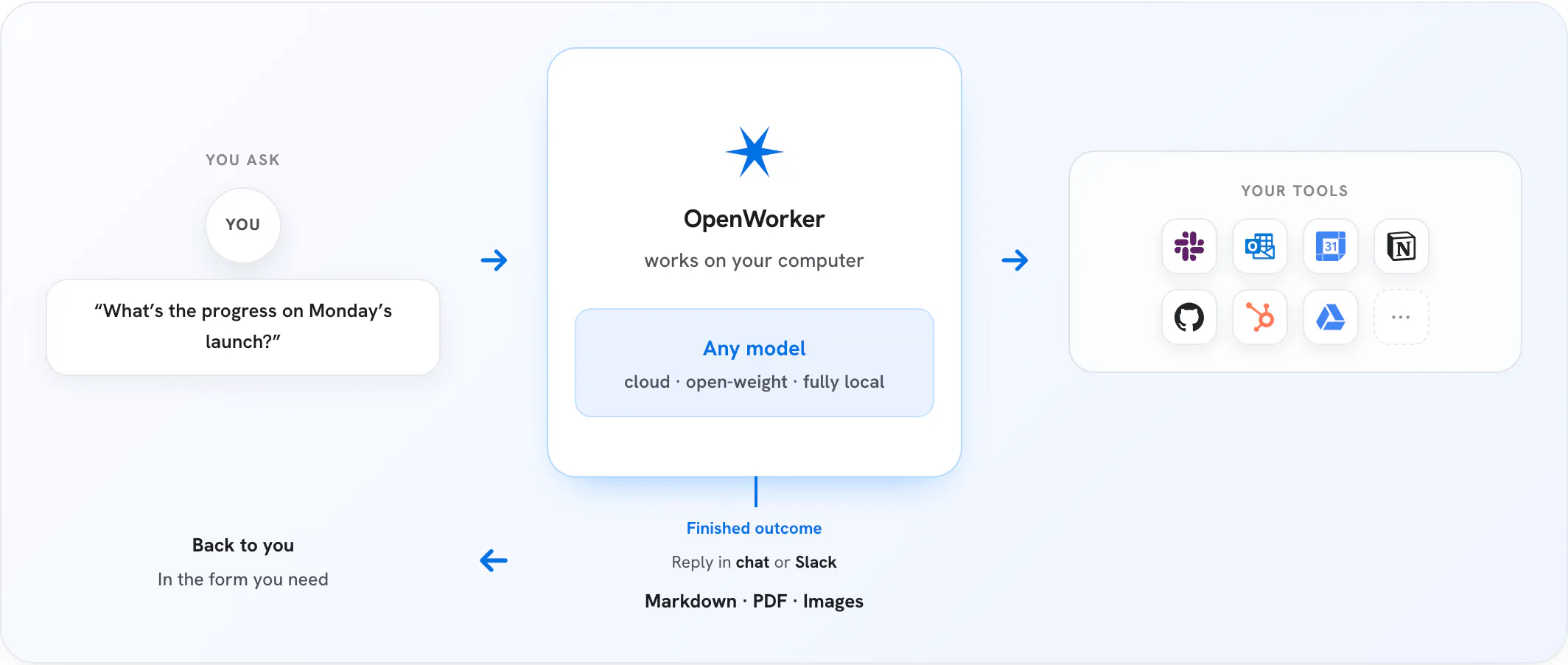
About OpenWorker
Reviews 5
-
Elmer Schoen 3 months ago
Would this be better than Anahata ASI?
-
Buck Yundt 4 months ago
local-first plus BYOK is the right pitch for this, since the whole appeal falls apart if my files still round-trip through someone's cloud to pick the next action. curious about the "checking in before anything important" part specifically - is that a fixed list of action types (sending a message, deleting a file, etc) that's the same for everyone, or can I define what counts as important for my own setup? a Slack reply might be harmless for one person and exactly the thing I never want auto-sent for another.
-
Nils Auer 4 months ago
Congrats on the launch! This looks like a very smart project! Quick question do you think your app could handle responding to my coworkers in Microsoft Teams? I have also built a quick demo for you https://app.livedemo.ai/livedemos/6a63e3a2cc86a442a8fd9975
-
Al Wolf 4 months ago
Local-first is a big differentiator in a space that's mostly cloud-dependent right now — especially for anyone wary of sending desktop activity to a remote server. What's the trade-off been like performance-wise, running everything on-device instead of offloading to the cloud?
-
Dejon Bergstrom 4 months ago
A local-first, open-source desktop agent is well aimed at the teams that cannot send their work to someone else's cloud. That is a real segment and an underserved one. From launching developer products, the story that converts is dependability on a narrow set of tasks people do daily, so I would show it winning at three specific workflows rather than promising general autonomy.