

About Silent Interpreter
Reviews 2
-
Jaylon Deckow 2 months ago
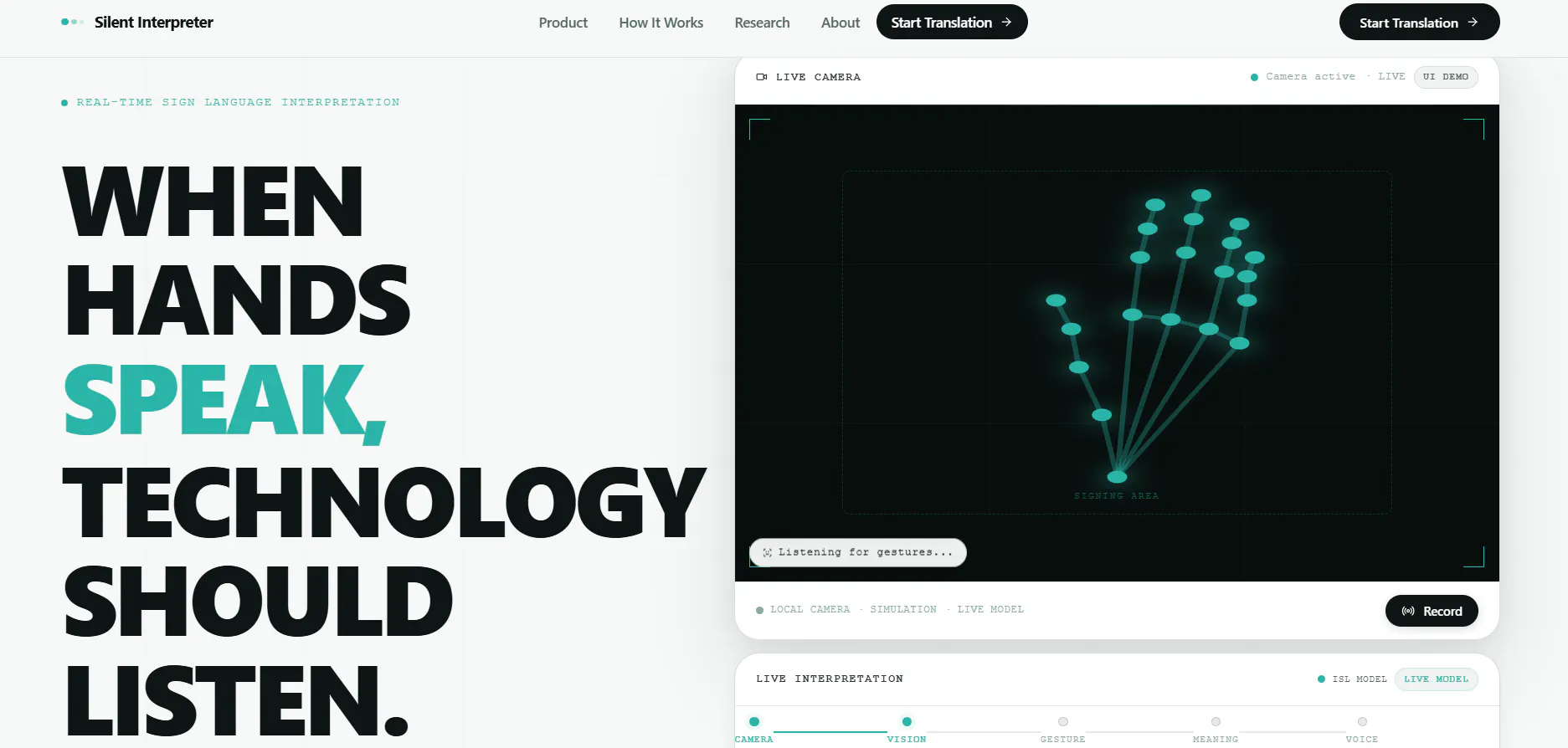
The problem India has millions of Deaf and hard-of-hearing signers, but Indian Sign Language (ISL) is one of the most under-resourced sign languages in the world when it comes to AI tooling. Most sign-language tech you've heard of targets ASL. ISL has had almost none of that attention. fewer datasets, fewer models, fewer products. We set out to build something narrower but real: a live isolated-sign interpreter, point a camera at someone signing a single ISL word, and see (and hear) the translation instantly, entirely on-device. Why "isolated," not "continuous" Fluent, continuous sign language: full sentences, signed at natural speed is still a genuinely unsolved research problem, for ISL or any sign language. It requires modeling grammar, facial non-manual markers, and knowing where one sign ends and the next begins, all with almost no continuous-sentence training data available for ISL. So we scoped down to something achievable: one sign at a time, recognized reliably, rather than a fluent conversation handled badly. That's a real, useful building block and honestly, most sign-language products that actually ship work this way too. How it works Training (Google Colab): - Pulled ISL video data from INCLUDE, the largest available isolated-sign ISL dataset (AI4Bharat), covering 263 distinct signs. - Extracted hand and body landmarks from every video using MediaPipe pose (33 points) plus both hands (21 points each) rather than training on raw pixels. This is dramatically more data-efficient and is the standard approach across current ISL research. - Trained a Bidirectional LSTM classifier on these landmark sequences, with regularization tuned to avoid overfitting on a modest dataset. - Exported the trained model to TensorFlow.js, so it can run directly in a browser no server, no API calls, no sending anyone's camera feed anywhere. Live inference (the web app): - MediaPipe runs live in the browser, extracting the same landmarks from your camera feed in real time. - A motion-based segmentation system watches for when your hands start moving (a sign beginning) and go still again (a sign ending) rather than blindly chopping the video into arbitrary time windows. - The captured sign gets resampled to match the exact format the model was trained on, then classified. - The result appears as text and gets spoken aloud instantly, so a hearing person in the room doesn't even need to be looking at the screen. What we learned the hard way The model itself was, honestly, the easy part. The real war was fought in dependency hell: MediaPipe deprecated its entire Python API mid-project, TensorFlow's newest releases broke the model-conversion tooling in about five different, increasingly obscure ways, and we eventually had to spin up a whole separate, older Python environment just to get a trained model out of Colab in a usable format. Where it stands, and where it's honestly limited - Trained on 261 of INCLUDE's 263 sign classes. - Runs fully client-side camera in, prediction + speech out, nothing leaves the device. - Like any ISL model trained on a modest, non-crowdsourced dataset, accuracy will vary by sign, by signer, and by how closely someone's signing style matches the training videos. This is a prototype demonstrating a real, working pipeline not a clinically validated interpreting tool. - Real-world deployment of anything like this should involve Deaf and ISL-fluent reviewers from the start, not just after the fact. What's next Expanding vocabulary coverage, tightening segmentation for faster/slower signers, and the much harder frontier eventually exploring continuous, sentence-level ISL recognition, which remains an open problem the research community (including groups like RKMVERI) is actively working on.
-
Johnpaul Crona 2 months ago
it's far from perfect but every bit of it is real, please try it, break it, tell us how to make it better, your feedback genuinely means the world right now 🫂