

About Spine Swarm
Reviews 15
-
Joaquin Wisozk 8 months ago
Congrats on the launch. The lead agent coordinating a swarm of specialists is a genuinely interesting architecture, and the focus on non technical operators feels like the right bet. Most powerful AI tools still assume developer workflows, so that angle opens a much wider market. One messaging thought: the benchmark claims against OpenAI, Anthropic, and Gemini are a strong hook, but one concrete example of what Spine handled better would make it land harder. Right now it reads as a claim. A specific task turns it into proof. Curious who's adopting fastest, builders experimenting with agent workflows or operators automating real business tasks? I work with SaaS teams on launch messaging and positioning, so I'm always trying to understand where new categories actually get their first traction. Excited to see where this goes.
-
Charley Swift 8 months ago
Sounded lovely and so I jumped in, still working on my first task with spine, will update this once done with it. I have already emailed the first feedback to the team, and hoping to get a timely response. So far, fingers crossed! Thanks guys!
-
Daren Bruen 8 months ago
Curious how Spine handles credential scoping across agents when each agent needs its own set of API keys or OAuth tokens, do you isolate those at the agent level or pool them at the workspace level? That architecture choice tends to cascade into a lot of downstream access control decisions.
-
Rupert Emmerich 8 months ago
Interesting concept. The idea of multiple specialized agents working in parallel instead of one model handling everything sounds powerful. I like that the result is a finished deliverable rather than just a chat response. How does Spine decide which of the 300+ models to use for each step of the task?
-
Rahul Goyette 8 months ago
Hey my name is Ramadan, I came across Spine and the idea of coordinating AI agents to handle complex tasks is really interesting. While exploring the site, I noticed the experience takes users straight to login without first explaining the product or showing how the workflow actually works. For a tool this powerful, that might make it harder for new users to quickly understand the value. I’m a UI/UX designer focused on designing experiences for users. It's products like this that small UX changes can help users grasp the product faster. If you're open, I’d be happy to share a few quick ideas that could improve how new users understand and engage with the platform.
-
Adam Zemlak 8 months ago
Looks dope guys. What are cases you think this would outperform (either in accuracy, cost, latency, etc.) something like Claude Code subagents or agent teams?
-
Elmer Schoen 8 months ago
I’m really excited about Spine and had the chance to test out Spine Swarm during a recent product team offsite. We were exploring ways to quickly prototype ideas and initially planned to spin up an OpenAI project and iterate on prompts to feed into Figma Make. Instead, we leveraged Spine and it streamlined the entire workflow. Having all the context in one place meant we could move faster and spend our time actually building prototypes instead of stitching tools together.
-
Al Wolf 8 months ago
This is pretty good!
-
Santa Cassin 8 months ago
Interesting system design here. From the description it feels like Spine behaves closer to an orchestration layer coordinating swarms of agents rather than just a typical AI workspace. Curious how the team internally thinks about that distinction.
-
Elias Rowe 8 months ago
Curious how the swarm coordination actually works when agents hit conflicting conclusions mid-task — like if one agent's research contradicts another's during a 50-page strategy doc. That's where these multi-agent setups tend to fall apart in my experience. The visual canvas angle is smart though, auditability is genuinely the missing piece in most AI workflows right now. Most people don't trust the output because they can't see how it got there.
-
Jaylon Deckow 8 months ago
Love it! Can't wait to try this out on marketing ops. Supported and shared on our channels. :) Best of luck!
-
Kenneth Corwin 8 months ago
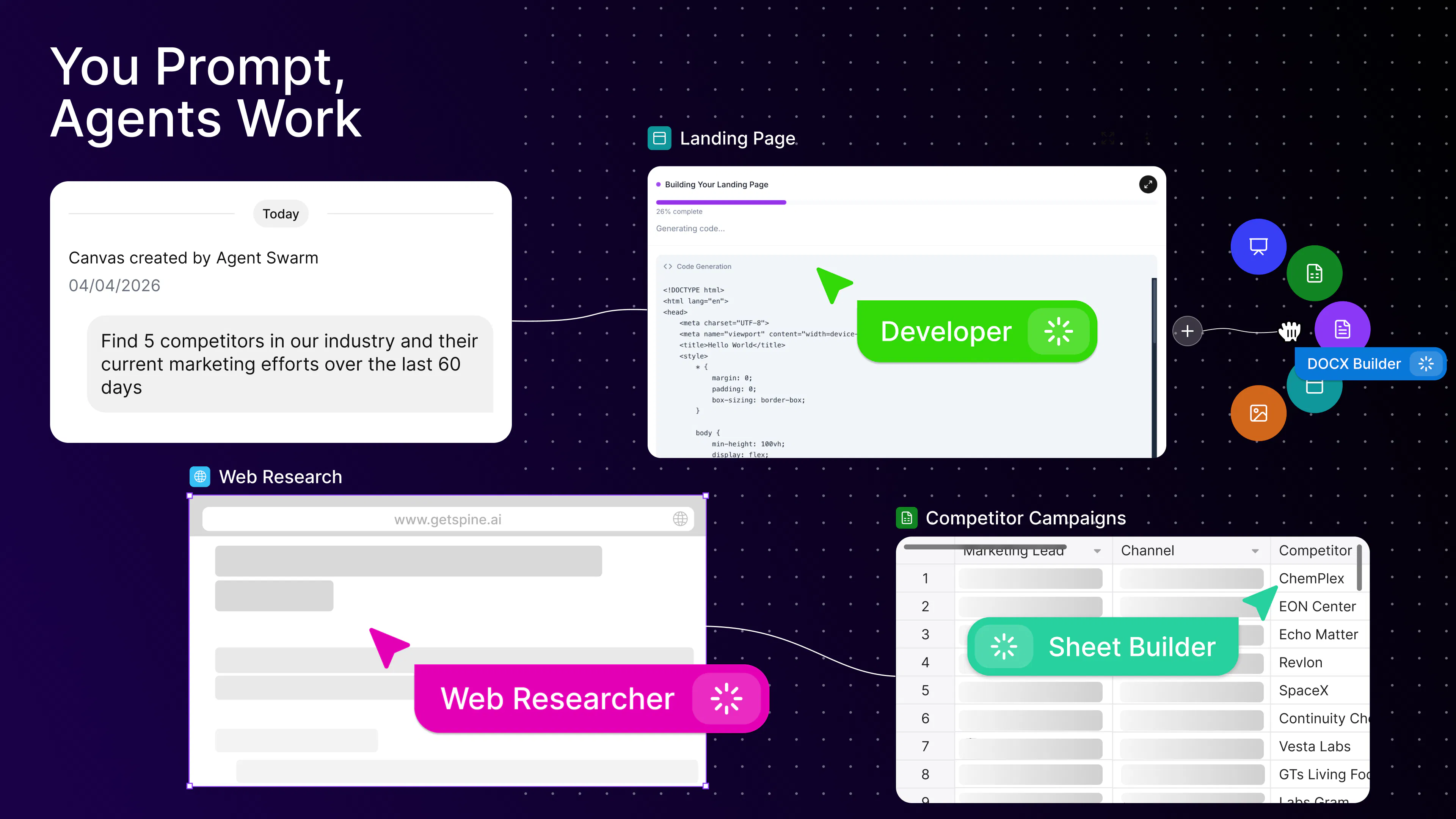
I've watched people use this for the first time and the moment it clicks is always the same, they don't just prompt and wait as AI goes behind a black box to stitch up an answer, but prompt and watch as their specialised AI workforce comes together in parallel to deliver real work, live. Couldn't be prouder of what this team built. Go try it!
-
Monserrate VonRueden 8 months ago
Canvas over chat - that just makes more sense for real work. When I'm jumping between research, code, and product decisions, linear chat loses context fast. Love the branching idea. Quick question - can you connect outputs between blocks automatically or is it all manual?
-
Eino Klein 8 months ago
The idea of spinning up specialized agents in parallel and picking the best model for each step is really smart. Most AI tools try to do everything with one model, which leads to mediocre results across the board. The visual canvas where you can watch agents work in real time is a nice touch too — transparency in how AI arrives at deliverables builds a lot of trust.
-
Tyrique Lind 8 months ago
Interesting architecture. Orchestrating multiple specialized agents across 300+ models to decompose long running tasks into structured outputs on a shared canvas is a strong systems design choice. Curious how you handle task routing, intermediate state management, and verification of outputs between agents to maintain consistency.