

About Visdiff
Reviews 15
-
Enrico Wiza 7 months ago
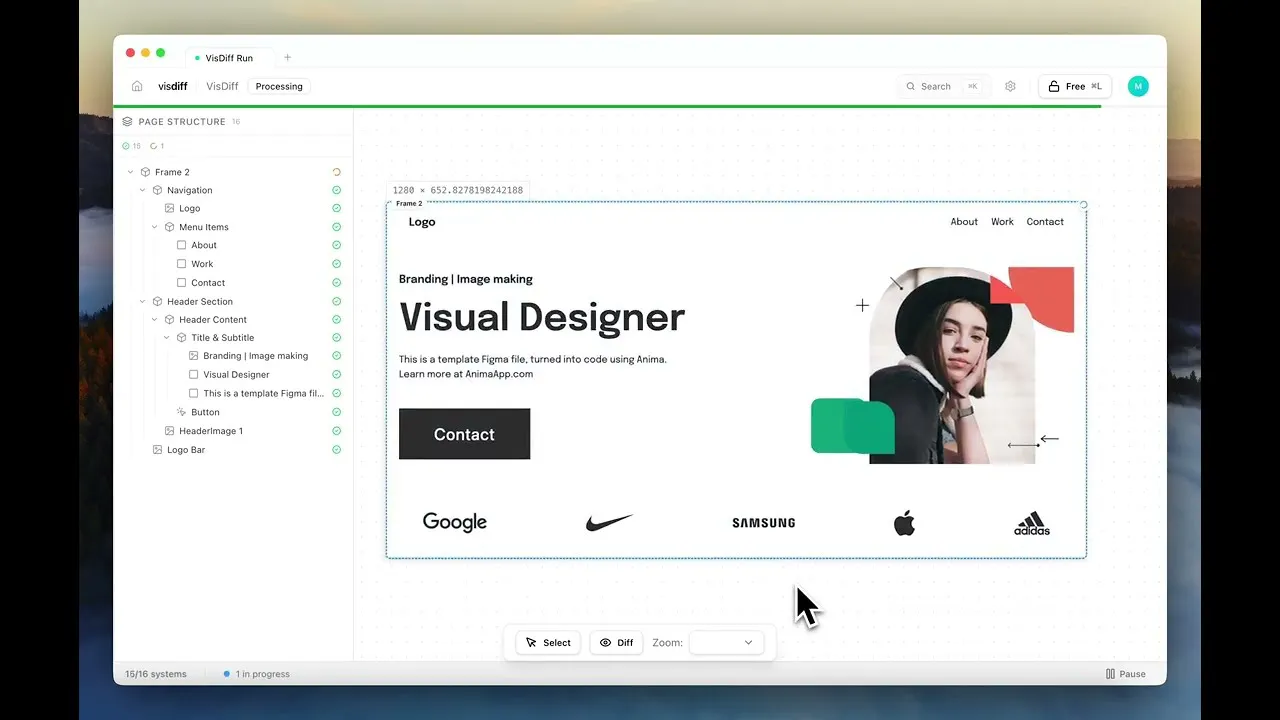
The problem you're solving isn't bad AI code. It's the missing layer between generation and truth, and that's a much harder thing to name clearly. What stands out isn't the diffing. It's the closed loop. Most tools stop at detection and hand the problem back to a human. Visdiff turns design accuracy into something that converges on its own. That's a fundamentally different product category than QA. The framing worth leaning into: You're not a QA tool; you're a rendering authority. If this works reliably, pixel perfect stops being a subjective handshake and becomes an enforced outcome. That's the kind of positioning shift that makes a specific buyer feel like this was built exactly for them. Curious how Visdiff handles intentionally ambiguous designs. Does it force precision or adapt to it?
-
Marcus Macejkovic 7 months ago
Nice work! Does your product also adjust figma files foor a given product? I currently have the problem, that I have a website and no figma files. I would love to use figma, but I am too lazy to "re-engineer" everything in figma.
-
Rahul Goyette 8 months ago
Can I define my own styles before starting a project? In other words, is there a proper flow for legacy projects?
-
Floyd Botsford 8 months ago
Design-to-code handoff has been broken forever and pixel-level visual diffing in CI could actually fix it. Does it catch CSS issues like spacing/font rendering differences across browsers too, or just layout-level changes?
-
Michel Heathcote 8 months ago
Hey team,  congrats on the launch! Will definitely check it out.  Well written tagline and description. I think the problem you’re trying to solve is very clear…for now.  Curious about your long term vision for the project given how fast vibe design and coding tools are evolving. I personally have had increasingly less issue with this as MCP and tools like Figma Make, Stitch, etc. get better.
-
Adam West 8 months ago
What happens when design intent conflicts with implementation constraints, does it keep iterating or surface the tradeoff?
-
Elmer Schoen 8 months ago
Hey man, this is a really cool product. Looking forward to trying it out! :)
-
Malachi Armstrong 8 months ago
The Figma URL approach with no setup is a big deal. I've used Cursor to build UIs from Figma screenshots and the spacing is always slightly off. Does it work with any frontend framework or are there specific ones it handles best?
-
Uriah Mayer 8 months ago
How does it handle responsive designs where the same component looks different across breakpoints? Congrats on the launch!
-
Gaylord Buckridge 8 months ago
so sick! congrats on the launch!!
-
Maxwell Blanda 8 months ago
This looks promising, and I can see the value when Figma and the codebase are perfectly in sync. However, in practice, production environments often diverge from the original designs—whether it’s updated iconography or elements that were cut during development but never reflected back in Figma. How does your tool manage these discrepancies between the 'source of truth' in design and the actual live implementation?
-
Lamont Strosin 8 months ago
Congratulations on the launch 🚀
-
Randi Prohaska 8 months ago
Does it work with my existing design system ?
-
Jedidiah Farrell 8 months ago
How is this different from other Figma-to-code tools ?
-
Orrin Batz 8 months ago
As someone that has experienced their design come out completely different when it gets implemented as code.... I love this idea. Are there certain differences that Visdiff have trouble detecting versus ones that it is best at?